
This article is written by Poonam B. Bharwani | Yoga Therapist | Certified Yoga Teacher | Author | Healthy Ageing Advocate | Yoga for Women 35+ | Holistic Wellness | Panchakosha philosophy | Ayurvedic lifestyle principles | Prakriti-based nutrition | Know more about Poonam.
If you are a woman over 35 thinking about starting yoga, you may be wondering, is it too late to start yoga after 35? The good news is that you can begin even if you have little flexibility, lead a sedentary lifestyle, or have never attended a yoga class before. What matters most is choosing the right starting point and progressing at a pace that suits your body.
As a Certified Yoga Teacher, I work with women over 35 to help them stay active, improve flexibility, reduce joint stiffness, and enjoy better overall health through yoga. I have also published a book on this subject – Graceful Years After 35 – A Yogic Path to Pain-Free Joints and Inner Glow.
So, let me address some of the common concerns you may have about starting yoga after 35 and help you understand how to get started.
Is It Too Late to Start Yoga After 35?
No, 35 is certainly not too late to start yoga. There is no age at which you need to stop learning new asanas or developing your flexibility, strength, and balance. Whether you are 36, 45, or 55, you can begin with simple practices suited to your current physical ability. Yoga for women in their 40s is becoming very popular as more women prioritise maintaining good health and overall wellbeing.
Many women spend their 30s and 40s looking after everyone around them – their children, parents, families, and careers. Somewhere along the way, their own wellbeing slips down the list of priorities. Over time, some women begin to experience joint stiffness, disturbed sleep, fatigue, and a general feeling of slowing down, making it harder to maintain an active lifestyle.
This is when myths start to feel like facts. Some common myths women believe are “At my age, aches and pains are to be expected,” “I’m too old to start yoga,” “I need to become thinner before I start exercising,” “I am not flexible enough,” etc.
As a yoga teacher focusing on women over 35, I believe this is precisely when we need to change our relationship with movement. Yoga should not become another demanding responsibility. Instead, it should be a little time we give back to ourselves – an opportunity to move more freely, build strength and flexibility, and find a sense of calm in our busy lives.
Yoga and Ayurveda teach us that the body has a natural capacity to heal, adapt, and regain balance when supported by mindful movement, proper nourishment, adequate rest, and a healthy lifestyle.
In Yoga and Ayurveda, pain is not treated as an “enemy” but often viewed as a “message” from the body – a reminder to pause and pay attention to what our body needs. Stiffness, tension, or discomfort may indicate that we need to adjust our movement, posture, or daily habits. However, sharp, persistent, or worsening pain should never be ignored, as it may require medical attention, and Yoga teaches us to move with awareness, respect our body’s limitations, and not force ourselves through pain.
Do not worry if you have never practiced yoga; begin with the basics. Starting yoga does not mean you must be flexible or perform complicated asanas. It means moving your body regularly and taking time for your wellbeing at this stage of life.
What Really Changes in a Woman’s Body After 35?
Our bodies continue to change throughout adulthood, although these changes do not happen at the same age or at the same pace for everyone. While joint stiffness becomes more common, it is not inevitable. The body does not “suddenly” change after 35 – but life and biology begin to shift.
As women move through their late 30s and 40s, their bodies continue to undergo gradual changes. For some, the early hormonal changes associated with perimenopause may begin during this period, affecting sleep, mood, energy levels, and overall wellbeing.
Muscles that support the spine and major joints – such as the knees, lower back, neck, and shoulders – also begin to weaken. Knees hurt while climbing stairs, the lower back aches while bending or lifting, and the neck and shoulders stiffen after long hours in front of screens. Much of this is due to poor posture, weak muscles, inflammation, and accumulated stress.
While these changes are a natural part of life – yoga, mindful breathing, and healthy lifestyle habits may help manage stress, improve sleep, and support emotional wellbeing during hormonal transitions.
Some common changes include:
- Muscle loss: We gradually lose muscle mass and strength as we age, particularly if we remain physically inactive.
- Reduced flexibility and mobility: Limited physical activity and long hours of sitting can contribute to stiffness and restricted movement.
- Bone health: Bone density can decline with age, particularly around menopause.
- Changes in balance: Muscle strength and balance may gradually decline, affecting stability and coordination.
- Sleep and stress: Work pressures, family responsibilities, and hormonal changes may affect sleep and overall wellbeing.
This does not mean every woman over 35 will experience these changes. However, it is a good time to pay greater attention to physical activity, strength, and overall health. This is the phase when the body needs a different kind of care than what it needed in the 20s.
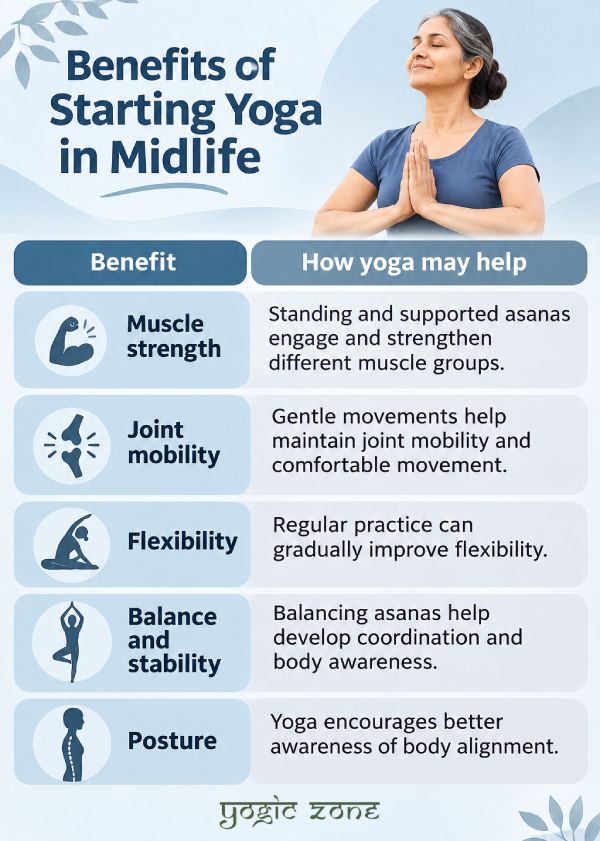
Five Benefits of Starting Yoga in Midlife
Regular yoga practice can help women maintain physical fitness, mobility, and mental wellbeing. It combines stretching, strengthening, balance, breathing, and relaxation, making it a useful addition to an active lifestyle.
| Benefit | How yoga may help |
|---|---|
| Muscle strength | Standing and supported asanas engage and strengthen different muscle groups. |
| Joint mobility | Gentle movements help maintain joint mobility and comfortable movement. |
| Flexibility | Regular practice can gradually improve flexibility. |
| Balance and stability | Balancing asanas help develop coordination and body awareness. |
| Posture | Yoga encourages better awareness of body alignment. |
If you are already following other forms of exercise, you do not need to stop them. Yoga can complement your existing fitness routine and other healthy lifestyle habits.
However, it does not replace medical treatment or guarantee protection against age-related conditions. Painkillers and medical support are essential when required, but relying solely on them without making lifestyle changes often leads to recurring pain. Modern medicine combined with yoga, Ayurvedic lifestyle principles, and emotional balance creates a powerful healing system.
Enjoying this article? Want to know more about my yoga practice, class location, and the courses and packages I offer? Learn more about my classes and connect with me.
Which Type of Yoga Should You Start With?
For many beginners, a gentle, beginner-friendly Hatha yoga class is a suitable starting point. It generally allows time to understand alignment, breathing, and the basic movements of individual asanas without rushing through a sequence.
Here is a simple comparison of different yoga styles:
| Yoga Style | What Beginners Can Expect | Suitability |
|---|---|---|
| Gentle Hatha Yoga | Basic asanas, controlled movements, and breathing | A good starting option |
| Restorative Yoga | Supported, comfortable positions and relaxation | Useful for relaxation and gentle practice |
| Vinyasa Yoga | Sequences linking movement with breath | Faster-paced classes may be easier after learning the basics. |
| Yin Yoga | Longer-held stretches with an emphasis on relaxation | May suit some beginners with appropriate guidance |
If you are completely new to yoga, look for a beginner-friendly class where the instructor explains alignment and offers suitable modifications. We have an article, How to Find a Yoga Class That’s Right for You, to help you choose the right class.
Six Beginner – Friendly Yoga Asanas
You do not need a long list of asanas when starting yoga. A few basic movements that help develop mobility, strength, and balance are enough to establish a foundation.
Here are six beginner-friendly asanas that women over 35 can explore with appropriate modifications:
| Asana | Main Purpose | Beginner Tip |
|---|---|---|
| Tadasana (Mountain pose) | Improves posture, alignment, and body awareness, reduces stiffness, and lengthens spine. | Keep feet hip-width apart if bringing them together feels uncomfortable or unsteady. Avoid locking the knees. |
| Marjaryasana-Bitilasana (Cat-Cow pose) | Improves spinal mobility and encourages movement with breathing | Place a folded mat or blanket under the knees and move slowly with the breath. |
| Balasana (Child's pose) | Encourages relaxation and gently stretches the back and hips | Use a cushion for support. Skip it if kneeling causes discomfort. |
| Baddha Konasana (Butterfly pose) | Helps improve hip mobility | Sit on a folded blanket or cushion and avoid forcing the knees towards the floor. |
| Setu Bandhasana (Bridge pose) | Strengthens the hip muscles, back, and hamstrings | Begin with a small, comfortable lift and avoid straining the neck or lower back |
| Vrikshasana (Tree pose) | Develops balance, coordination, and concentration | Keep one hand on a wall or chair for support. Place the raised foot on the ankle or calf, never directly on the knee. |
These six asanas are my recommendations for women over 35 who are beginning their yoga practice. However, not every asana will be suitable for everyone. An asana that feels comfortable for one woman may not suit another, particularly if she has existing joint or back problems.
It is perfectly fine to use a chair, wall, cushion, or yoga block. These props provide support and allow you to practice with greater comfort and control.
Include Breathing and Healthy Daily Habits in Your Routine
Yoga is not limited to practicing asanas.
Yoga, Ayurveda, and Panchakosha together offer a holistic approach to healthy and graceful ageing. While yoga supports physical strength, flexibility, and mental calm, Ayurveda encourages a balanced daily routine, a Dincharya of regular sleep, nourishing meals, gentle movement, and mindful relaxation.
According to the traditional yogic concept – our body is not just a physical body, but it is made up of five layers, i.e., Panchakosha, which include the physical body, breath, mind, inner awareness, and sense of contentment, and it is essential to not only nurture our physical body but also to achieve an alignment between all five layers.
Remember, looking after yourself involves more than physical exercise. Giving attention to your breathing, sleep, and everyday habits can make your yoga practice more meaningful.
Although this is not a replacement for medical treatment when it is needed, practicing yoga in a holistic way can be very beneficial for your overall health.
Remember, Yoga is not about touching your toes; it is about touching your life with awareness.
Simple 15-Minute Yoga Routine for Beginners
It is not important to practice yoga for an hour to experience its benefits; just 15 minutes a day of simple, soft movements and consistent changes can completely shift the direction of your health and wellbeing.
Practising Yoga for even shorter duration regularly can help improve flexibility, support mobility, can make us feel calmer, and reduce stress. This will also help us adopt a healthier and more active lifestyle.
Never force a posture that causes pain. Remember consistency matters more than intensity.
Just 2 minutes of gentle shoulder and joints warm-up, 8 minutes of simple asanas such as Tadasana (Mountain pose), Marjaryasana-Bitilasana (Cat-Cow), Baddha Konasana (Butterfly Pose), and Vrikshasana (Tree Pose can be supported), 3 minutes of gentle breathing such as Bhramari Pranayama (Bee Breath – gently inhaling and making a soft humming sound while exhaling, which makes you feel calmer and more relaxed), and finishing with 2 minutes of relaxation in Shavasana can transform your life.
Important Safety Tips Before Starting Yoga After 35
Starting gradually is more important than trying to achieve flexibility quickly. Give yourself time to understand the movements and how your body responds to them.
When starting yoga, keep a few things in mind:
- Warm up first: Begin with gentle joint movements and simple mobility exercises.
- Pay attention to alignment: Be mindful of the position of your knees, hips, shoulders, and spine.
- Breathe naturally: Avoid holding your breath while performing an asana.
- Use modifications: Props such as cushions, yoga blocks, and chairs can make certain asanas more comfortable.
- Progress gradually: Increase the duration and difficulty of your practice as your comfort and ability improve.
- Listen to your body: Stop or modify an asana if it causes pain. Allow adequate rest between sessions.
When to Consult a Doctor Before Starting Yoga
Women with persistent knee pain, back pain, or other joint problems should consult their doctor before starting yoga, particularly if certain movements aggravate their symptoms.
Extra care is also necessary if you have osteoporosis, uncontrolled blood pressure, cardiovascular conditions, recent surgery, or a history of significant injuries.
Depending on your health condition, certain movements, such as deep forward bends, forceful twists, and demanding backbends, may need to be avoided or modified.
If you are unsure whether a particular asana is suitable, consult your doctor and work with a suitably qualified yoga instructor.
Remember, yoga should not be about competing with someone else or pushing through pain.
How Often Should you practice Yoga
Consistency matters more than the duration of an individual session. You do not need to spend an hour practicing yoga every day when you are just beginning.
You could begin with two or three sessions a week and gradually increase the frequency as your comfort and confidence improve.
The best routine is one that fits into your daily life and that you can continue without feeling overwhelmed.
Make Yoga a Part of Your Life, Not Another Responsibility
The most meaningful change after 35 may not be achieving a difficult asana or touching your toes. It may be getting out of bed without stiffness, climbing stairs more comfortably, feeling stronger during everyday activities, or finding a few peaceful moments in a busy day.
Do not measure your progress by comparing yourself with younger practitioners or people who have been practicing yoga for years. Your body, lifestyle, and starting point are different.
Yoga for women over 35 is not about trying to turn back the clock. It is about caring for your body, maintaining your independence, and enjoying the years ahead with greater strength, mobility, and confidence.
Do you have any doubts or questions about this article?? Poonam B. Bharwani, the author, would love to hear from you. Send us your question now!
Frequently Asked Questions About Yoga for Women Over 35
Can I start yoga at 35 with zero flexibility?
Yes, you can start yoga with zero flexibility. You do not need to touch your toes or perform difficult asanas. Begin with simple movements and gentle stretches and let your flexibility improve gradually.
Is it safe to do yoga after 35 if I have lower back or knee pain?
Yes, yoga may be suitable if your back or knee pain is properly assessed. Consult your doctor before starting, and practice with a qualified instructor who can suggest suitable modifications. Never push through pain.
How often should a beginner woman over 35 practice yoga to see results?
Start with two or three sessions a week. Even 20 to 30 minutes per session can help you build consistency. Gradually increase the duration and frequency as your comfort and confidence improve.
Can I start yoga at home after 35 without risking a neck or back injury?
Yes, you can start yoga at home, provided you practice carefully. Follow beginner-level instructions, learn correct alignment, and avoid advanced asanas. If you have existing neck or back problems, seek professional guidance first.
Should I avoid Surya Namaskar if I am a complete beginner over 35?
No, you do not have to avoid Surya Namaskar. However, learn the correct technique first and begin with a few slow, modified rounds. If you have joint, back, or blood pressure concerns, seek guidance before practicing.
Is it safe to practice yoga during periods or early perimenopause after 35?
Yes, gentle yoga is generally safe during periods and perimenopause. Adjust your practice according to how you feel. Choose comfortable asanas and relaxation and avoid movements that cause discomfort.
What if I feel too stiff or overweight to keep up with a regular yoga class?
You do not need to be slim or flexible to join yoga. Look for a beginner-friendly class where the instructor offers modifications. Use a chair, wall, or other props whenever needed, and progress at your own pace.
Should I choose Hatha yoga or power yoga when starting in my late 30s?
Choose gentle Hatha yoga when starting in your late 30s. It generally offers a slower pace and more time to learn alignment and breathing. You can explore power yoga later as your strength and confidence improve.
Is it necessary to practice yoga early in the morning on an empty stomach?
No, morning yoga on an empty stomach is not compulsory. You can practice at a time that suits your routine. Ideally, allow two to three hours after a full meal or about an hour after a light snack.
Can I build real muscle and bone strength after 35 with just beginner yoga?
Yes, yoga can help build muscle strength and support bone health. However, beginner yoga alone may not provide enough stimulus for optimal muscle and bone development. Complement it with suitable strength and weight-bearing exercises.