
Certified Yoga Trainer | PG Diploma in Yoga | 200 Hours TTC from International Yoga Alliance | 8 yrs experience | Chair Yoga | Classical & Therapeutic Yoga Specialist | Pranayama | Meditation | Yoga Nidra | Know more about Rahul Singh.
If you have ever looked at a yoga class advertisement and thought, “I wish I could do that,” you are not alone. Many people who contact me about joining a yoga class think they need to be flexible before they can start. They tell me their body feels stiff after years of desk work and inactivity. Some struggle with back pain; others have knee discomfort or stiffness around the hips. Their question is usually the same: “Can someone like me actually do yoga?”
My answer is always yes. In fact, many people start their yoga journey with chair yoga because it feels safer, more comfortable, and easier than getting down on the floor. Chair yoga for beginners is one of the most accessible forms of seated yoga, and it suits people looking for gentle yoga for stiff bodies.
As a certified yoga instructor, I have been teaching yoga for the past eight years. Over the years, I realised that many people who wanted to learn yoga needed a gentler and more accessible starting point.
That is one of the reasons I introduced chair yoga for beginners into my curriculum. It gave people a simple and approachable way to begin their practice, and many were surprised by how much they could do with the support of a chair.
The Biggest Myth About Yoga: You Need to Be Flexible First
You do not need to be flexible to start yoga. You simply need a practice that suits your body and allows you to move comfortably and confidently. You start yoga, and flexibility gradually develops.
The misconception about flexibility as a requirement is very common; many people associate yoga with advanced postures, forward bends, or sitting comfortably in Padmasana (Lotus Pose). Social media images often reinforce the idea that you need a very flexible body for yoga.
In reality, yoga is about awareness, breathing, and mindful movement. Flexibility is the outcome of regular practice.
Why Chair Yoga Is Easier to Start Than Regular Yoga
Chair yoga removes two of the biggest obstacles beginners face:
- Getting down to the floor
- Getting back up again
For people with knee discomfort, back stiffness, balance concerns, or limited mobility, getting started with traditional yoga can sometimes feel difficult.
If back pain is your main reason for trying chair yoga, combining these movements with a simple, beginner-friendly yoga sequence for back pain relief can help you address back pain more systematically.
Chair yoga for beginners is a popular form of adaptive yoga that allows people to practice with greater comfort, confidence, and support.
A chair provides support, stability, and confidence.
Rather than worrying about balance or flexibility, you can focus on breathing and moving comfortably. This often helps beginners relax, which is important because a relaxed body tends to move more freely than a tense one.
If you are older or supporting a parent who is worried about balance, a gentle chair yoga sequence created specifically for seniors can be a reassuring first step.
The Household Chair Audit
If you are starting your chair yoga practice at home, I recommend giving your chair a quick safety check before you begin. Practicing chair yoga at home is a practical choice for people who cannot attend classes regularly, particularly for those dealing with stiffness around the hips and back pain.
Many Indian homes have polished marble, vitrified tiles, or smooth granite flooring, which can cause chairs to shift or slide during movement.
Use the checklist I have put together to create a safe and stable practice space.
| Chair Type | Stability & Safety | What to Do |
|---|---|---|
| Heavy wooden dining chair | Best choice | Place a folded rubber bath mat underneath to prevent sliding on tiles. |
| Plastic moulded chair (Nilkamal-style) | Usable with caution | Use only against a wall; place on a rubber mat; avoid poses that shift weight sideways. |
| Cushioned sofa-style chair | Avoid | Too unstable and too low; the soft seat makes alignment impossible. |
| Office chair on wheels | Avoid entirely | The wheels make every movement unsafe; avoid using for yoga |
| Metal folding chair (stackable) | Acceptable | Lightweight, so always position it against a wall; use a rubber mat beneath. |
Safety Tip: One of the most important safety tips is to position your chair against a wall before you begin. This simple step helps prevent the chair from shifting or sliding during twists, forward leans, and other movements.
Do you have any doubts or questions about this article?? I am Rahul Singh, the author, and I would love to hear from you. Send me your question now!
Start with Sukshma Vyayama, Not Stretching
If your body feels stiff, resist the temptation to jump straight into stretching. In yoga, we often begin with Sukshma Vyayama (Subtle Joint Movements), a series of gentle joint movements that prepare the body for practice.
Just three to five minutes can help your joints feel more mobile and make the rest of your chair yoga session more comfortable.
• Gulpha Chakra Kriya (Ankle Circles)
How it helps: Encourages gentle movement in the neck and shoulders, helping to ease stiffness caused by prolonged sitting and screen time.
Safety: Move slowly, hold the chair for support, and only move as far as you feel comfortable.
• Manibandha Chakra Kriya (Wrist Rotations)
How it helps: Relieves stiffness in the wrists and fingers caused by typing, mobile phone use, writing, and other repetitive hand movements.
Tip: Keep elbows relaxed.
Safety: Reduce movement if you experience discomfort.
• Greeva Sanchalana Kriya (Neck Mobility)
How it helps: Releases the tension that commonly builds up in the neck and upper shoulders from long hours of screen use, driving, and everyday stress.
Tip: Use small, controlled movements.
Safety: Avoid throwing the head backward.
10-Minute Chair Yoga Routine for Very Stiff Beginners
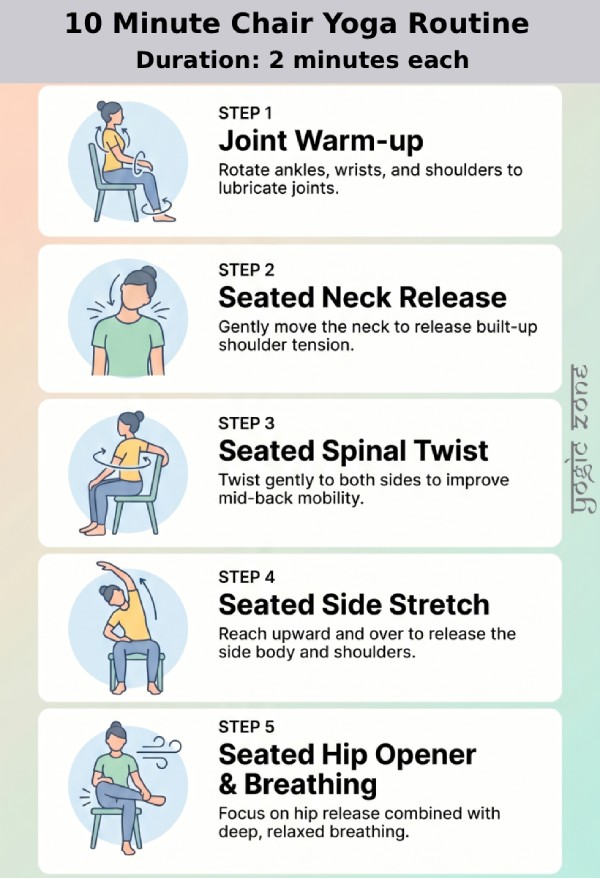
Once your joints feel warm and your body is moving more freely, try this simple 10-minute chair yoga routine. The goal is not to stretch deeply but to help your body move comfortably and confidently.
These chair yoga exercises are designed as a beginner yoga routine. The timings are only a guide, so feel free to spend a little more or less time on any movement depending on how your body feels that day.
| Duration | Practice | Sanskrit Name | Focus |
|---|---|---|---|
| 2 minutes | Ankle Circles, Wrist Rotations, and Shoulder Rolls | Gulpha Chakra + Manibandha Chakra | Joint warm-up (Sukshma Vyayama) |
| 2 minutes | Seated Neck Release | Greeva Sanchalana | Neck and shoulder tension |
| 2 minutes | Seated Spinal Twist (both sides) | Vakrasana Variation | Mid-back mobility |
| 2 minutes | Seated Side Stretch | Parsva Urdhva Hastasana Variation | Side body and shoulder release |
| 2 minutes | Seated Hip Opener with Relaxed Breathing | Sukhasana Variation + Deep Breathing | Hips and relaxation |
In my classes, I encourage beginners, especially seniors, to spend a few weeks getting comfortable with the warm-up routine before worrying about more structured yoga practice.
Systematic reviews of chair-based exercise for older adults show meaningful improvements in functional health and physical performance, especially when programs are followed consistently over several weeks.
4 Simple Chair Yoga Poses for Beginners
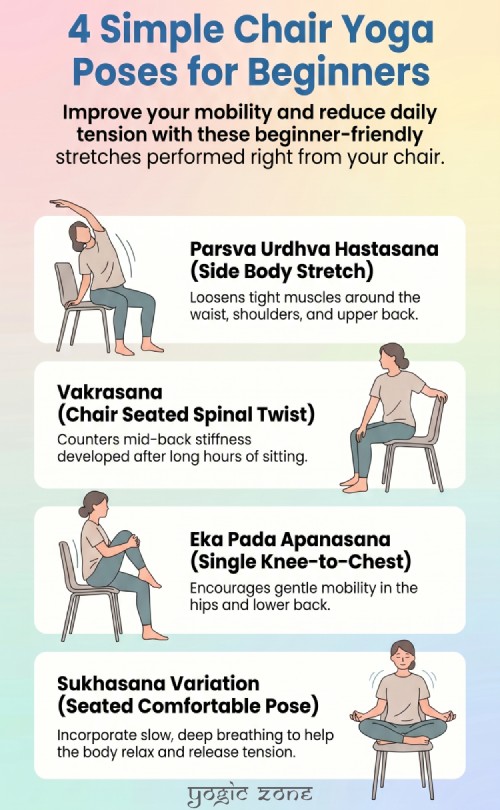
Once these movements start feeling natural, you can explore a few foundational chair yoga asanas. These chair yoga poses for beginners are designed to support improved flexibility and mobility; they form the backbone of many beginner chair yoga sessions and can be easily adapted to suit different mobility levels.
1. Parsva Urdhva Hastasana (Chair Seated Side Body Stretch)
This is one of the easiest chair yoga poses for beginners. The movement is simple, requires very little flexibility, and can be comfortably practiced by most people, even if they spend long hours sitting at a desk.
- Benefit: This gentle chair-seated stretch helps loosen tight muscles around the waist, shoulders, and upper back. This can feel particularly beneficial after spending long hours working at a desk or looking down at a screen.
- Safety: If you feel pinching in the lower back or shoulder, reduce the lean and focus on reaching upward through the raised arm instead.
2. Vakrasana (Chair Seated Spinal Twist)
This simple chair seated twist is an excellent introduction to spinal movement. It is easy to perform from a chair and can help beginners become more aware of how their spine moves during everyday activities.
- Benefit: Encourages gentle movement through the mid-back and helps counter the stiffness that can develop after long hours of sitting. Many beginners find that this pose helps them feel more comfortable and mobile throughout the day.
- Tip: If the chair back feels too far away to hold comfortably, place a rolled cotton dupatta across the back and hold the ends instead.
- Safety: Let the movement come from the mid-back rather than the neck. Avoid turning your head further than feels comfortable. If you have a history of disc problems, keep the twist gentle and stop if you experience pain, tingling, or numbness.
3. Eka Pada Apanasana (Chair Seated Single Knee-to-Chest)
This beginner-friendly asana gently brings the hips and lower body through a comfortable range of movement. It is particularly useful for people who spend long hours sitting and want to practice chair yoga without placing pressure on their knees.
- Benefit: Encourages gentle mobility in the hips and lower back, two areas that often become tight after prolonged sitting. It can be a comfortable way to bring movement into the lower body while remaining fully supported by the chair.
- Tip: Sit straight before lifting the knee. If reaching the shin feels difficult, hold behind the thigh instead. If your foot does not reach the floor or your hands cannot comfortably hold your leg, a simple yoga block can bring the floor closer and reduce strain while you sit.
- Safety: Move slowly and avoid pulling the knee forcefully towards the chest. If you experience pain, tingling, or symptoms that travel down the leg, release the pose and seek guidance from a qualified healthcare professional or your yoga teacher.
4. Sukhasana Variation with Deep Breathing (Chair Seated Comfortable Pose)
This calming practice combines a comfortable seated position with slow, mindful breathing. It provides a gentle way to end your chair yoga session and helps you shift your attention from movement to relaxation.
- Benefit: Slow, deep breathing encourages the body to relax and release unnecessary tension. In my experience, many beginners find that focusing on their breath helps them move more comfortably and confidently during practice.
- What you feel: A gentle expansion of the abdomen and rib cage as you inhale, followed by a relaxed release as you exhale.
- Safety: Breathe naturally and comfortably. Avoid forcing deep breaths or holding the breath for longer than feels comfortable.
Note: The asanas mentioned here are recommended by our qualified and experienced authors for general awareness and inspiration. We do not provide step-by-step instructions, as each individual’s physical condition and needs are unique. We strongly recommend learning yoga under the guidance of a qualified instructor who can offer personalised support and ensure safe practice.
When Should You Seek Professional Guidance?
Chair yoga is designed to be accessible, but it is still important to listen to your body and work within your current abilities.
Before starting a new yoga practice, it may be helpful to speak to your doctor or a qualified yoga teacher if you have recently had surgery, have severe osteoporosis, experience significant balance challenges, have uncontrolled blood pressure, or notice persistent pain, numbness, or tingling during movement.
In my experience, a few simple modifications are enough to make chair yoga for beginners more comfortable and suitable. A qualified healthcare professional or experienced yoga teacher can help you identify the safest approach for your situation.
Simple additions like a cushion behind the back or a few beginner-friendly yoga props that work well with a chair can make each pose feel more supported and less intimidating.
If you have been avoiding yoga because you think you are too stiff, too inflexible, or out of shape, I encourage you to rethink what yoga actually means. Yoga is not about forcing your body into difficult positions. It is about practicing within your comfort level while gradually improving strength and mobility.
Chair yoga for beginners offers a practical starting point for people who want to improve mobility, build confidence, and reconnect with movement without the pressure of traditional floor-based practice.
As a low-impact yoga option that can be practiced at home, it asks very little of you to start. All you need is a sturdy chair, a few minutes each day, and a willingness to begin are all you need.
Do you have any doubts or questions about this article?? I am Rahul Singh, the author, and I would love to hear from you. Send me your question now!
Frequently Asked Questions About Chair Yoga For Beginners
Can seniors with knee pain safely do chair yoga?
Yes, it is highly safe. Chair yoga completely removes weight from your lower joints, protecting sensitive knees. It allows seniors to build strength and mobility without the fear of falling or worsening arthritic pain.
Is chair yoga as effective as regular yoga for beginners?
Absolutely, yes. You get the exact same respiratory, circulatory, and mental benefits. By adapting traditional asanas to a chair, beginners can experience deep stretching and mindfulness without straining stiff muscles.
Do I need a special type of chair for online yoga classes?
No, any sturdy, flat-surfaced chair without wheels works perfectly. Avoid soft sofas or rotating office chairs. Ensure your feet flatly touch the ground; use a yoga block or a firm cushion underneath if needed.
What if my feet don’t touch the ground comfortably while doing chair yoga?
Simply slide forward or place a firm cushion or block under your feet. It is vital for your feet to be fully grounded to support your spine and keep your posture aligned during the practice.
Should I do chair yoga every day if I have severe back stiffness?
Yes, doing 10 to 15 minutes daily is ideal. Gentle, consistent movement is the best cure for office workers dealing with chronic stiffness from long hours of sitting at a desk.
Is it safe to practice chair yoga alone at home if I am over 60?
Generally, it is safe if you use a stable chair against a wall. However, always listen to your body. Move slowly, skip any twist that hurts, and focus on deep breathing rather than forcing flexibility.
Can I lose weight or burn fat by only practicing chair yoga?
While it burns fewer calories than intensive cardio, it boosts metabolism and lowers cortisol (stress hormones) that trigger belly fat. It is an excellent, sustainable starting point for a healthier lifestyle.
What if I feel a sharp pinch in my lower back during a chair twist?
Stop immediately and ease out of the posture. Gentle stretching is good, but sharp pain means you have gone too far. Always keep your spine straight and twist only as far as your breath allows comfortably.
Can I practice chair yoga right after having a heavy meal?
No, it is better to wait at least two hours. Even though it is gentle, pranayama (breathing exercises) and mild twists require an empty stomach to prevent bloating, acid reflux, or general discomfort.
Should I avoid chair yoga if I have high blood pressure or vertigo?
Generally, it is safe, but avoid sudden head movements or lowering your head below your heart. Keep your gaze fixed forward, breathe calmly, and always inform your instructor about your condition beforehand.