
Ph.D. Vedic Yogas | M.Sc. in Psycho Neurobics | Yoga Therapist (AYUSH) | Sports Councillor | 10+ years of experience in yoga, meditation & mental health | Amazon Bestselling Author | Know more about Dr. Aradhana Singh.
If you have been a regular walker for years, you probably have your familiar route, your walking group, and conversations about the latest news and your locality. Walking is a wonderful habit, but over time it can become mechanical, just steps without awareness. That’s where walking yoga comes in.
It doesn’t mean giving up your group walks or friendly chats; it’s an additional practice you can add to your existing routine. Yoga walk is a calming, restorative experience that blends mindfulness, breath awareness (pranayama), and gentle postural alignment. Each step becomes a chance to release stress, sharpen focus, and reconnect with yourself.
As a Level 6 yoga therapist with over ten years of experience, I focus on bringing together the traditional wisdom of yoga and meditation with modern approaches like psycho-neurobics. With a doctorate in sports counselling, my aim is to keep these practices simple and accessible for everyday life.
What Is Walking Yoga and How Is It Different from a Regular Walk?
Walking yoga is a mindful walking practice where breath, posture, and awareness are synchronised with each step. Unlike a brisk walk that focuses on speed or calories, this practice is about rhythm, presence, and internal balance.
In short, it is the practice of turning an ordinary walk into a moving meditation through breath coordination, postural alignment, and present-moment awareness.
In the Buddhist-yogic tradition, mindful walking is known as Chankramana, a practice rooted in Vipassana and ancient Vihara disciplines described in early Indian texts. (Read this if you want to know more about Chankramana.)
Yoga walking draws inspiration from this tradition but adds conscious pranayama and active postural alignment, making it a calming, restorative experience for modern wellness seekers.
In Western wellness circles, this is often called walking meditation, though the yogic version adds pranayama and postural work that makes it distinctly more therapeutic. It is not a passing fitness trend but a way to reconnect with your body and mind through every step.
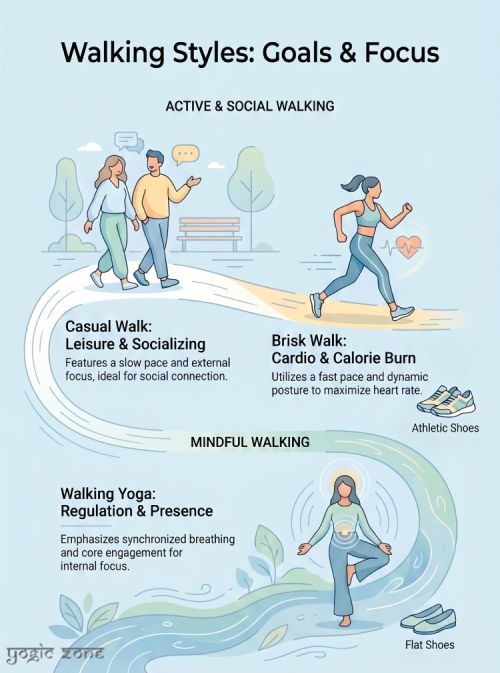
To understand how a yoga walk differs from a regular walk, let’s look at the key features side by side.
| Feature | Casual Walk | Brisk Walk | Walking Yoga |
|---|---|---|---|
| Primary goal | Leisure, socialising, light movement | Cardiovascular endurance, calorie burn | Nervous system regulation + posture + presence |
| Breath | Unregulated, conversational | Heavier, unregulated | Conscious Pranayama synchronised with steps |
| Posture focus | Relaxed, often slouched | Incidental - driven by pace | Active: spine long, shoulders released, gaze soft |
| Pace | Slow, social | Fast to moderate | Slow to moderate, deliberate |
| Mental state | Chatty, present but external | Often distracted (phone, music) | Present-moment awareness, internally focused |
| Time needed | 30-60 min for social benefit | 30-60 min for full benefit | Even 10 minutes offers measurable calm |
| Footwear / surface | Any comfortable footwear | Running or walking shoes | Barefoot on grass is ideal; flat shoes on concrete are fine |
| How it fits in | Your existing group walk routine | Your existing fitness routine | Layers onto either - no need to replace what you already do |
I have observed that those who combine their usual walk and yoga walking in one session get the best results. Reserve the final ten to fifteen minutes for yoga walking.
If you prefer a visual overview, here’s a quick comparison to help you see the differences at a glance:
Walking Yoga Benefits for Mind and Body
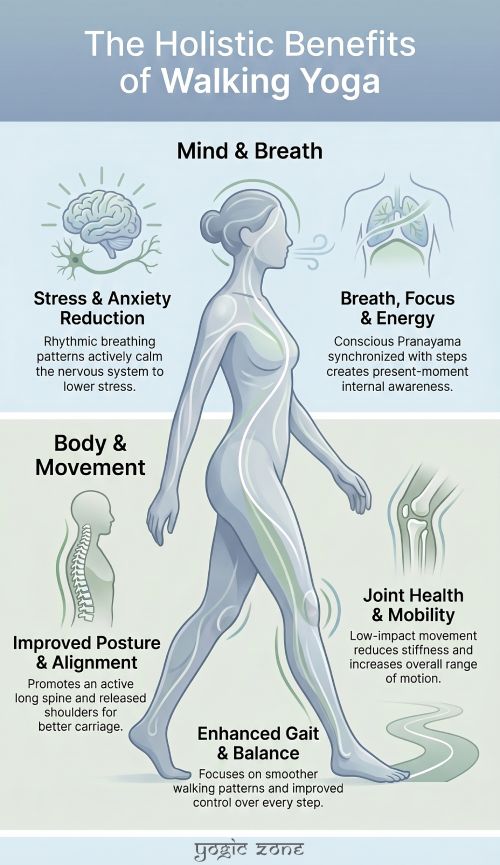
Walking yoga supports both physical ease and mental calm by combining gentle movement with conscious breathing. It can improve posture, joint mobility, and overall body awareness. These benefits are also supported by research, including a randomized controlled study on mindful walking in people with high psychological stress.
I have put together a simple table below to help you quickly see some of the key benefits of walking yoga.
| Area | How It Helps | Who Benefits Most |
|---|---|---|
| Stress & Anxiety | Breath rhythm calms the nervous system and supports relaxation | Anyone under chronic stress |
| Posture | Encourages upright alignment and better body awareness while moving | IT professionals, students, commuters |
| Joint Health | Low-impact movement supports joint comfort and helps reduce stiffness | People with mild knee concerns, older adults, and athletes |
| Mobility | Improves range of motion and makes movement feel easier | Older adults, people with stiffness, and sedentary individuals |
| Gait Improvement | Supports smoother walking pattern, better step control, and more efficient movement | Older adults and those recovering from inactivity |
| Breath Capacity | Gradually improves breathing control and lung efficiency | For everyone |
| Balance and Coordination | Improves body awareness, steadiness, and movement control through synchronized steps and breath | Older adults and those recovering from a sedentary period |
| Focus | Builds concentration through step awareness, breath awareness, and present-moment attention | Students, professionals, and anyone with mental fatigue |
| Energy Levels | Steady breath and movement help reduce sluggishness and lift vitality | For everyone |
Here’s a simple visual summary of how walking yoga supports both the body and the mind:
A Step-by-Step Walking Yoga Plan for Beginners
When I teach walking yoga, I make sure it doesn’t look like you are doing yoga. At the same time, the transformation happens internally and remains invisible to onlookers. Here are the steps I recommend.
Step 1: Set your base posture before you begin – Tadasana Alignment
- Stand still for 30 seconds with your feet hip-width apart. Ensure all parts of your feet are grounded evenly.
- Keep your shoulders relaxed, chest open, and chin parallel to the ground.
Benefit: Improves postural alignment and breathing.
Beginner tip: Let your head be gently lifted upward.
Common beginner mistake: Over-straightening or stiffening the body.
Step 2: Breath Synchronisation (4–4 Method) – Sama Vritti Pranayama
- Begin walking at a comfortable pace.
- Inhale slowly through the nose for 4 steps.
- Exhale slowly through the nose for 4 steps.
- Keep it natural, not forced.
Benefit: Breathing exercises while walking, like this 4-4 method calm the mind and stabilise energy. You will feel a gentle warmth in the chest and a quieting of inner chatter within 3–5 breath cycles.
Common beginner mistake: Most beginners hold their breath slightly; keep it soft and continuous.
Step 3: Mindful Step Awareness
- Notice the heel-to-toe movement as you walk.
- Feel each step making contact with the ground.
- Keep your gaze soft rather than fixed.
Benefit: Builds focus, somatic awareness, and reduces mental clutter.
Beginner tip: Let your attention rest lightly on the sensation of walking.
Step 4: Optional Pause with Vrikshasana — Tree Pose
- After a few minutes, pause briefly and stand on one leg for a modified Tree Pose.
- Use a wall or tree for support if needed.
Benefit: Improves balance and stability.
Safety note: Avoid this if you feel dizzy or have balance issues.
Do you have any doubts or questions about this article?? I am Dr. Aradhana Singh, the author, and I would love to hear from you. Send me your question now!
Can You Practice Mudras While Walking? (Without Feeling Awkward)
In my classes, I teach what I call “stealthy mudras.” Simple, subtle hand positions you can use without drawing attention, especially in public parks.
- Chin Mudra (modified): Let your arms hang naturally. Gently touch the index finger and thumb on each hand. From the outside, it looks like relaxed fingers. Internally, this closes an energetic circuit and sharpens focus.
- Dhyana Mudra (in pocket): If you have pockets, rest your hands inside with palms facing up, thumb and forefinger lightly touching. Completely invisible and quietly grounding.
The Urban Survival Guide: Managing Noisy Environments
Practicing in busy city environments can be challenging. Between traffic noise and constant movement around you, it’s easy to get distracted.
Acknowledge: Instead of fighting the noise, acknowledge it as part of the surroundings. Use ear muffs or ear defenders to cut off loud noise.
So-Ham internal mantra: If the external world is too loud, anchor your mind by mentally repeating the sound “So” on the inhale and “Ham” on the exhale. Know more about So-Ham mantra.
The Indoor Alternative for Monsoon Day
During the monsoon, regular outdoor walks can get disrupted. Wet surfaces, puddles, and uneven ground can make mindful walking difficult. This is where a simple indoor practice works well.
- The Living Room Practice: You don’t need a park to find your rhythm. Walking yoga can be practiced in a corridor or even a small living room by walking slowly in a gentle figure-eight pattern.
- Treadmill Integration: If you have access to a treadmill, keep the speed slow to moderate (around 3 to 4 km/h). This allows you to stay focused on posture and breath rather than just keeping up with the belt.
Safety Note: On days when air quality is poor, it’s best to avoid walking outdoors. Move your practice indoors where you can breathe comfortably and safely. If air pollution levels are high, yoga for lung health gives your lungs a daily “reset” by improving capacity, clearing mucus, and calming irritated airways.
Walking Yoga for Athletic Recovery
Having worked with professional sports teams in the Pro Kabaddi League and with the Indian Railways handball and wrestling teams, I have found walking yoga workouts to be a simple way to support recovery after intense training.
Athletes and active individuals often focus on performance, but recovery is needed for the body to reset. A slow, conscious walking practice with breath awareness helps the system settle without adding more strain.
- Encourages a steady, natural breathing rhythm after workouts
- Helps release tension from repetitive training
- Supports active recovery by bringing awareness back to posture and movement patterns
You don’t need a separate session. Even 10 to 15 minutes of mindful walking after a workout or on rest days is enough. This is not about pushing further but allowing the body to recover in a more aware and balanced way.
Is Walking Yoga Safe for Knee Pain or Elderly Practitioners?
It is generally safe for elderly practitioners and those with joint issues as it’s gentler on the knees than brisk walking. The pace is slower, and the postural awareness reduces mechanical stress.
However, if you have diagnosed conditions such as osteoarthritis, post-surgical rehabilitation, or active joint inflammation, please consult your orthopedic specialist before beginning any new walking practice.
Below is a short safety guide I have put together:
| Condition | Guidance |
|---|---|
| Mild knee pain / arthritis | Walk at a slower pace on flat ground. Avoid balance poses like standing on one leg. Check with your doctor if unsure. |
| Varicose veins | Keep a gentle, continuous movement. Avoid standing still for too long. |
| Vertigo / balance issues | Avoid standing on one leg. Keep your gaze steady and both feet grounded. |
| High AQI | Avoid walking outdoors. Practice indoors or on a treadmill. |
| After a heavy meal | Wait at least 90 minutes. A light walk after fruit or chai is fine. |
| Pregnancy | Consult your gynecologist. Gentle walking is usually fine, but avoid deep breath-holds. |
What Should You Wear for Yoga Walking?
You can practice yoga walking in almost anything you are comfortable in, including sarees, formal wear, or your regular walking clothes. The key is ease of movement and a steady posture. Read this article on the ultimate guide to yoga clothes for women.
I have seen people practice this during office breaks, in everyday footwear, and even in traditional clothing. It doesn’t need to look like a “yoga session.” To get started, just keep a few things in mind:
- Keep your steps slightly smaller and more controlled.
- Avoid tight or stiff footwear that restricts natural foot movement.
- Let your focus stay on breath rather than perfect movement.
When it comes to footwear, both being barefoot and wearing shoes can work.
- On grass or in a clean park, being barefoot can feel more grounding.
- Avoid very hard, flat footwear for long walks.
In urban Indian settings, I usually recommend supportive walking shoes to protect your joints. Comfort and safety matter more than following a rule.
Yoga Walk is not a replacement for your morning walk or your yoga class. it is a mindful movement practice you add on top of what you already do. It’s about changing how you walk.
In my experience, this is one of the most sustainable practices for Indian lifestyles. It fits into crowded schedules, doesn’t require space, and gently supports the mind-body connection.
Start small. Even a few mindful steps each day can shift how you feel. If you already walk, you’re halfway there. Now, just bring awareness into it.
Do you have any doubts or questions about this article?? I am Dr. Aradhana Singh, the author, and I would love to hear from you. Send me your question now!
Frequently Asked Questions About Yoga Walking
Can I do walking yoga if I have knee pain or joint stiffness?
Yes, walk gently. Keep steps small, avoid uneven ground, and focus more on breath than stride length. Walking yoga should feel supportive, not stressful. Stop if you feel discomfort.
Is walking yoga as effective as a 30-minute gym workout for weight loss?
They work differently. Walking yoga improves metabolism, reduces stress hormones, and builds consistency, all factors linked to weight management. It’s not a replacement for gym, but a powerful daily complement to it.
Should walking yoga be done on an empty stomach like traditional Yoga?
Ideally, yes. A light or empty stomach makes breath-work and movement more comfortable. A morning practice works best. If you practice after meals, wait at least 90 minutes and keep the pace gentle.
I am too embarrassed to do yoga poses in a public park. How can I practice walking yoga without looking like I am doing a weird workout?
The beauty of walking yoga is that it doesn’t look like yoga. You simply walk naturally while syncing breath and awareness. To others, it looks like a calm, regular walk.
Does walking yoga actually count as meditation, or am I just multitasking and losing the benefits of both?
It can be meditative if your attention stays on breath, steps, and body. If the mind wanders constantly, it becomes just walking. The intention and awareness make the difference.
I have a high-stress corporate job; will 15 minutes of walking yoga at lunch actually lower my cortisol, or is it just a placebo?
Yes, even short breaks can help you reset. A mindful 10–15 minute walking yoga session may ease mental clutter and help you return to work feeling steadier and more focused.
Can I listen to a podcast or music while doing walking yoga, or does that defeat the entire purpose of the ‘Mind-Body’ connection?
For walking yoga specifically, it does defeat the purpose. The practice requires internal awareness: breath, sensation, and gaze. Audio distracts, so save the podcast for your regular walk and keep this 15 minutes truly yours.
If I switch my morning walk to walking yoga, will I see an improvement in my posture and back pain faster than just regular walking?
Most likely, yes. Walking yoga emphasises spinal alignment, conscious foot placement, and shoulder relaxation with every step. Many people notice measurable postural shifts over 2–3 weeks of daily practice.