

This article is written by Yashvi Mehta. Certified Yoga Expert | Specialised in Hatha Yoga, Ashtanga Yoga, Yoga Nidra, Power Yoga, and Restorative Yoga | Personalised Individual Trainer | PG Diploma in Yoga Teaching (500 hrs) | PG Diploma in Dietetics, Health & Nutrition. Know more about Yashvi Mehta.
Living with knee discomfort often means more than just pain during exercise. It affects sitting on the floor, climbing stairs, and your daily routine. If you are planning to enroll in a yoga class and are wondering whether yoga with knee pain is safe or risky, let me guide you on what actually works, what to avoid, and how to practice rehabilitative yoga without making your knees worse.
I am a yoga teacher and health coach with over six years of experience, working with people of all ages. I create sessions that are safe, effective, and easy to adapt to individual needs. I focus on customised practices for concerns like injury recovery, knee pain, and flexibility.
Whether you have a recent injury or a chronic condition, choosing knee-friendly yoga practices can make a real difference to your quality of life. My aim is to make yoga accessible and supportive at every stage of your wellness journey.
What Kind of Knee Pain Are You Dealing With?
Before you decide what to practice or avoid, it helps to understand what kind of knee issue you are dealing with. Different knee conditions need different approaches in yoga.
Use this as a simple guide to match your knee with what’s generally safe.
| Condition | What it means | What's Safe |
|---|---|---|
| Osteoarthritis (most common 40+) | Joint cartilage has worn down. | Gentle movement helps; Bending the knee and impact aggravate. Therapeutic yoga asanas for knee pain work well here. |
| Meniscus tear (partial or full) | Cartilage cushion is damaged. Rotation under load is the key risk. | Many poses are safe; twisting and deep squats are not. |
| Ligament strain (ACL, MCL) | Stability is compromised. | Weight-bearing poses need controlled alignment. Use wall-support for Balance |
| Post-surgical (replacement or repair) | Healing tissue needs gradual load. | Follow your doctors clearance advise before starting yoga. |
| Patellofemoral pain (kneecap tracking) | Pain at the front of the knee, often on stairs. | Strengthening the muscles that support the kneecap should be the priority. Avoid poses that compress the kneecap directly. |
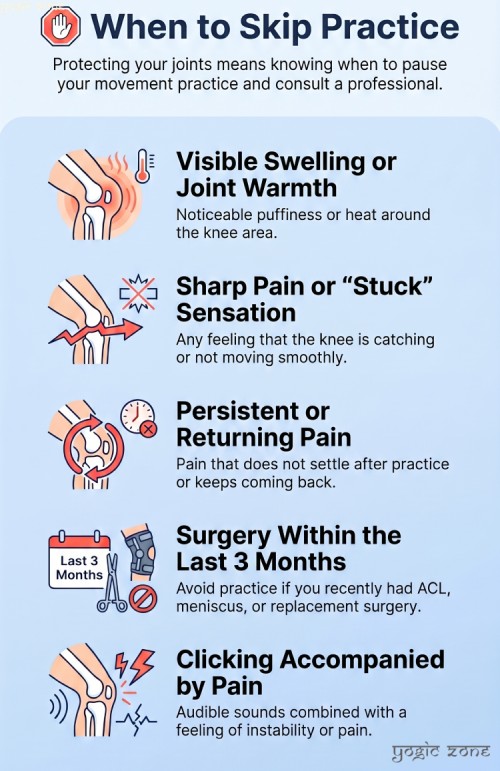
When to Skip Practice: Movements That Strain the Knee
You can practice most days with your existing knee condition, but on some days, you need to pause practice. I ask my students to consult me or a doctor if they notice any of the following:
- Visible swelling or warmth in the knee
- Sharp pain or the knee feeling stuck or not moving smoothly during movement.
- Pain that does not settle after practice or keeps returning
- Recent surgery (ACL—anterior cruciate ligament, meniscus, or knee replacement) within the last 3 months
- A clicking sound in the knee along with pain or a feeling of instability
The Right Style of Yoga for Knee Pain
Hatha yoga, practiced slowly with props and careful attention to alignment, is a good starting point when modifying yoga for knee pain. Chair yoga, which is essentially gentle yoga for people who cannot kneel or sit on the floor, can be even more suitable for students with significant discomfort. Read more about chair yoga.
Yin yoga can help improve hip mobility, which may reduce strain on the knees. However, it needs careful use of props so the knee is not kept deeply bent for long periods.
Therapeutic yoga, which draws from both classical Hatha and physiotherapy principles, is designed specifically for conditions like osteoarthritis and post-surgical recovery. If you are searching for yoga for knee injury recovery or yoga for osteoarthritis knee pain, this is the approach most likely to be both safe and effective.
If you are unsure about how your body responds to different styles, you can also read more about different types of yoga and how to choose what suits you on our detailed guide.
Yoga Asanas With Knee Pain: What Is Safe and Why
If your knees are already painful, the asanas below are generally safe because they either reduce load on the joint or help strengthen the muscles that support it. Think of these asanas as your starting set for yoga with knee pain. Each one is chosen for its ability to build knee-supporting strength without stressing the joints.
In my classes, I encourage the use of simple props, as they can ease strain on sensitive knees and make the practice more comfortable. Read about the benefits of yoga props and how they can make gentle practice safer and more accessible.
1. Setu Bandhasana (Bridge Pose) — Hip Muscles and Hamstring Strengthener
Why it helps: Strengthens the hip muscles and hamstrings (back thigh muscles), both of which reduce load on the knee. The knee itself bears no weight in this asana, making it one of the safest starting points for yoga for knee pain relief.
Prop: Place a firm cushion or folded blanket under your hips if staying in the pose feels tiring. Many students recovering from knee surgery find this to be one of the first asanas they can do comfortably when they start practicing.
Safety note: Keep your feet pointing straight ahead. Turning them out can strain the knee. You should feel the effort in the back of your thighs and your hips, which is correct muscle engagement.
2. Utkatasana Kriya (Modified Chair Pose) — For Thigh Strength
Why it helps: Strengthens the thigh muscles, especially the inner part that supports the kneecap. I have observed that this area is often weak in students with knee pain. Building strength here makes a noticeable difference.
Prop: Place a yoga block or bolster behind your knees; even a folded dupatta or rolled blanket behind your knees will work. It acts as a guide so you don’t bend too much.
Safety note: Keep your knees in line with your toes. If they fall inward, place a folded towel between your thighs and gently squeeze it. You should feel the effort in your thighs, not in your knees.
3. Janu Pindanasana (Supine Knee Hug) — Gentle Knee Movement
Why it helps: Gently moves the knee without strain and helps keep the joint well-lubricated. This supports comfort and ease of movement, especially when the knee feels stiff.
Prop: Loop a yoga strap behind your thigh for support; you can use a dupatta too. Hold the back of your thigh instead of the shin for support if moving the knee closer feels tight.
Safety note: Move slowly and stay within a pain-free range. Avoid pulling the knee too close to the chest if you feel pressure or discomfort in the joint.
4. Supported Sukhasana (Easy Seated Pose) — To Reduce Knee Strain
Why it helps: Many people with knee pain have stiff or tight hips. When the hips don’t move easily, the knee takes extra strain. This asana gently improves hip flexibility without putting pressure on the knees.
Prop: Sit on a cushion or folded blanket to raise your hips. Place pillows or folded towels under your knees for support.
Safety note: Keep the knees lower or on level with the hips. If you feel any discomfort in the knee, add more support or stretch the legs forward.
5. Patella Engagement Technique (Kneecap Tightening) — Gentle Strengthening Without Load
Why it helps: Activates the thigh muscles that support the kneecap without putting weight on the joint. It is safe even on days when the knee feels uncomfortable and is especially useful for kneecap-related pain.
Prop: Sit or lie down with the leg straight. You can place a small rolled towel under the knee for comfort and better support.
Safety note: Tighten the thigh to gently lift the kneecap, but do not strain or hold your breath. The movement is subtle. You should feel the effort in the thigh, not pain in the knee.
Note: The asanas mentioned here are recommended by our qualified and experienced authors for general awareness and inspiration. We do not provide step-by-step instructions, as each individual’s physical condition and needs are unique. We strongly recommend learning yoga under the guidance of a qualified instructor who can offer personalised support and ensure safe practice.
Yoga Modifications for Knee Pain: Common Poses Done Safely
These asanas are not off-limits, but they need small adjustments. These modifications for yoga with knee pain are straightforward. Without adjustment, the poses can strain the joint, but with the right changes, they can be very helpful.
Trikonasana (Triangle Pose) — Avoid Locking the Knee
Many students unknowingly lock or push the front knee back in this pose. It may look straight, but it puts extra stress on the joint.
Modification: Keep a slight bend in the front knee. Place a block or a thick book under your lower hand so you don’t lean on the knee. If you have a meniscus issue, this small bend is essential.
Virabhadrasana I & II (Warrior Poses)—Keep the Shin Upright
Virabhadrasana helps build strength, but only when alignment is right.
Modification: Keep the front shin upright, with the knee above the ankle. Take a shorter step than usual. Use a wall for support if needed. Hold for a few breaths instead of pushing too long.
Vrkshasana (Tree Pose) — Safe Foot Placement
Where you place your foot matters a lot in this asana.
Modification: Place your foot either below the knee (on the calf) or above it (on the thigh). Avoid placing it directly on the knee joint. Use a wall for balance if needed.
Do you have any doubts or questions about this article?? I am Yashvi Mehta, the author, and I would love to hear from you. Send us your question now!
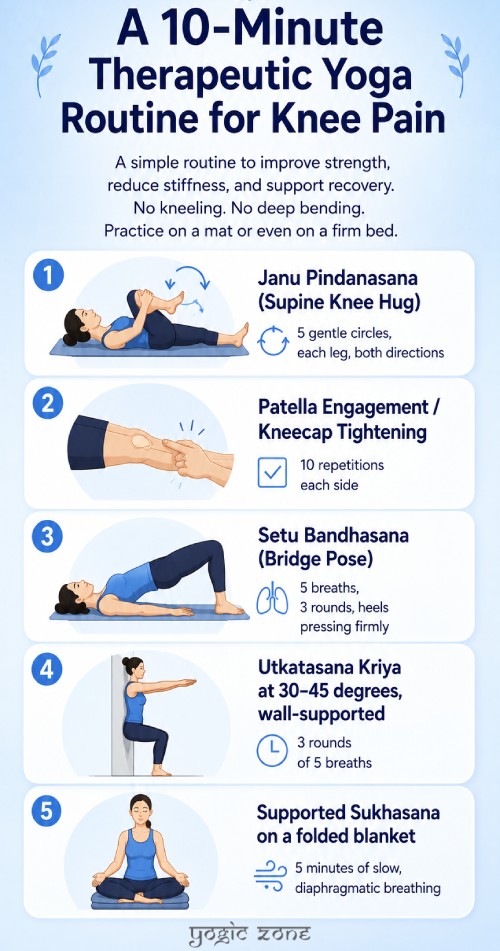
A 10-Minute Therapeutic Routine for Yoga With Knee Pain
This is a simple routine I share with most students who have knee pain. It avoids kneeling and deep bending. You can practice it on a mat or even on a firm bed, especially in the morning when the knee feels stiff. This daily yoga routine for knee pain can improve strength, reduce stiffness, and support recovery over time.
- Janu Pindanasana (Supine Knee Hug) — 5 gentle circles, each leg, both directions
- Patella Engagement / Kneecap Tightening — 10 repetitions each side
- Setu Bandhasana (Bridge Pose) — 5 breaths, 3 rounds, heels pressing firmly
- Utkatasana Kriya at 30-45 degrees, wall-supported — 3 rounds of 5 breaths
- Supported Sukhasana on a folded blanket — 5 minutes of slow, diaphragmatic breathing
Poses to Skip Until the Knee Is Ready
These asanas are best avoided for now, especially when the knee is painful or recently injured.
| Asana (Pose) | Why to avoid with knee pain |
|---|---|
| Padmasana (Lotus Pose) | Twists and bends the knee deeply, which can strain the joint. Best avoided for now. |
| Vajrasana (Thunderbolt Pose) | Puts full body weight on a fully bent knee. Can increase discomfort. |
| Malasana (Deep Squat) | Bends the knee too deeply under load. Not suitable for a sensitive knee. |
| Surya Namaskar (fast pace) | Quick lunges can strain and twist the knee. Try a slower, modified version later. |
| Balasana (Child’s Pose) | Deep bending compresses the knee joint. Use support or skip if uncomfortable. |
| Paschimottanasana (with towel behind knees) | Can push the knee into an unsafe position. Avoid placing anything behind the knee. |
I keep reminding my students that just because an asana is common doesn’t mean it’s right for your knee right now. Knowing which yoga poses to avoid with knee pain is just as important as knowing which ones help. Start when your knee feels safe.
What to Do After Practice: Ice, Heat, or Potli?
A little warmth or mild tiredness around the knee after yoga is normal. Here’s how to respond:
- Use cold (ice wrapped in a cloth for 10–15 minutes) if you notice swelling, warmth in the joint, or pain that increases during practice. Avoid heat in this case.
- Use heat (a warm compress, heating pad, or a potli with herbs) for stiffness, especially before practice. This is helpful if your knees feel stiff in the morning, which is common in colder weather.
- If the knee is swollen or inflamed, skip practice for the day. Missing one session is better than worsening the problem.
Yoga with knee pain is not only possible, but it can also be one of the most practical ways to support long-term joint health when you choose the right style, practice the right poses, and stay within your current range. Focus on strengthening the thighs and hips, and keep the joint moving in a pain-free way, as this is exactly what the knee needs.
A scientific study on the impact of yoga on patients with knee osteoarthritis found it to be effective in reducing pain and stiffness in patients with knee arthritis; it can also improve the physical function of patients.
Take your doctor’s clearance and work with a teacher who understands modifications. This is especially important for anyone practicing yoga after knee surgery or looking for safe yoga with knee replacement. Gradual, supported movement is the key.
The aim is simple: to move comfortably in daily life, whether that’s sitting on the floor, climbing stairs, or going about your routine without fear.
Do you have any doubts or questions about this article?? I am Yashvi Mehta, the author, and I would love to hear from you. Send us your question now!
Frequently Asked Questions About Yoga With Knee Pain
Is yoga safe for people with chronic knee pain or arthritis?
Yes, it is generally safe and highly recommended, provided you focus on alignment. Research shows yoga strengthens supporting muscles like quads and hamstrings, which reduces joint pressure. Always consult your doctor if you have severe swelling or a recent injury before starting.
Which yoga poses should I strictly avoid if I have bad knees?
Avoid poses like Padmasana (Lotus) and Virasana (Hero) without support, as they fully bend the knee and can strain the ligaments. Also avoid long forward steps where the knee goes past the ankle. Take a shorter step and keep the knee above the ankle to reduce pressure.
Can yoga help in curing knee pain naturally at home?
While yoga doesn’t “cure” wear and tear in the joint, it effectively manages pain by improving circulation and joint mobility. Regular practice of gentle asanas like Tadasana and Setu Bandhasana (bridge pose) builds a natural “brace” of muscle around the joint to provide long-term relief.
Can I still do yoga if my knees make a clicking or popping sound?
Yes, you can continue if the clicking is painless, but stop immediately if it’s accompanied by sharp pain or “locking.” Clicking often signals muscle tightness. Use a thicker mat under your knees to provide extra cushioning and prevent joint irritation.
Should I use a kneecap or brace while practicing yoga?
Generally, it’s better to avoid restrictive braces during yoga so your muscles learn to stabilise the joint. However, if you feel unstable, a light compression sleeve is fine. The goal is to eventually build enough strength through the poses to practice without any external support.
Is it safe to do Surya Namaskar if I have a meniscus tear or ACL injury?
No, it’s better to modify or skip the traditional flow during acute recovery. The quick transitions and long forward steps in Surya Namaskar can strain a healing ligament. Try a “Chair Yoga” version of the sun salutation to get the circulatory benefits without the weight-bearing stress.
What if my knee pain gets worse the day after a yoga session?
It’s a sign to slow down. While mild muscle soreness is normal, increased joint pain means you have overstretched or not properly aligned. Rest for 48 hours, use a warm compress, and when you return, focus on “micro-bending” your knees in standing poses to avoid locking them.
How often should a senior with weak knees practice yoga to see results?
Consistency over intensity is key. Aim for 15–20 minutes, 3 to 4 times a week. For seniors, focus on “Restorative” or “Hatha” styles. You will feel improved mobility within 4 weeks as the lubrication fluid in your joints increases, making movement feel much smoother.
Can I do yoga on a bed if I can’t sit on the floor due to knee pain?
Yes, practicing on a firm bed is a great way to start! Many effective knee-strengthening poses, like leg raises or reclining stretches, can be done safely on a mattress. This removes the “fear of falling” and the difficulty of getting up from the floor, making it very accessible.
Should I tell my yoga teacher about my knee pain before a group class?
Absolutely, you must inform them. An experienced teacher will offer specific modifications and provide props like blocks or bolsters to support your knees, reduce strain, and help you practice safely within your comfort range.