
MA Yogic Science | RYT 200 (Yoga Alliance USA) | 6+ yrs experience | Prenatal & Postnatal Yoga | Aerial Yoga | Women’s Wellness & Therapeutic Yoga Specialist | Know more about Lily Chetia.
If your yoga mat keeps slipping during practice, the problem may not be your balance or technique. Factors like mat material, the floor underneath it, sweat, cleaning material residue, or even the way you use it can all affect how stable it feels.
As an experienced yoga instructor, I have found that students often try to solve slipping issues by simply buying a thicker or more expensive mat. Buying a new mat does not always solve the real problem. Before replacing your mat, we should find out why it is slipping in the first place.
Over the years, I have observed seven common reasons why yoga mats do not stay in place and some practical suggestions to improve their grip and stability.
Yoga Mat Slipping? First, Find Out Where the Problem Is
Before we look at the possible causes in detail, here’s a quick way to narrow down the problem. Check whether your hands and feet are slipping on the mat’s surface or the entire mat is moving across the floor.
These are two different problems with two different solutions, and mixing them up is the most common reason students end up buying a new mat that doesn’t solve anything.
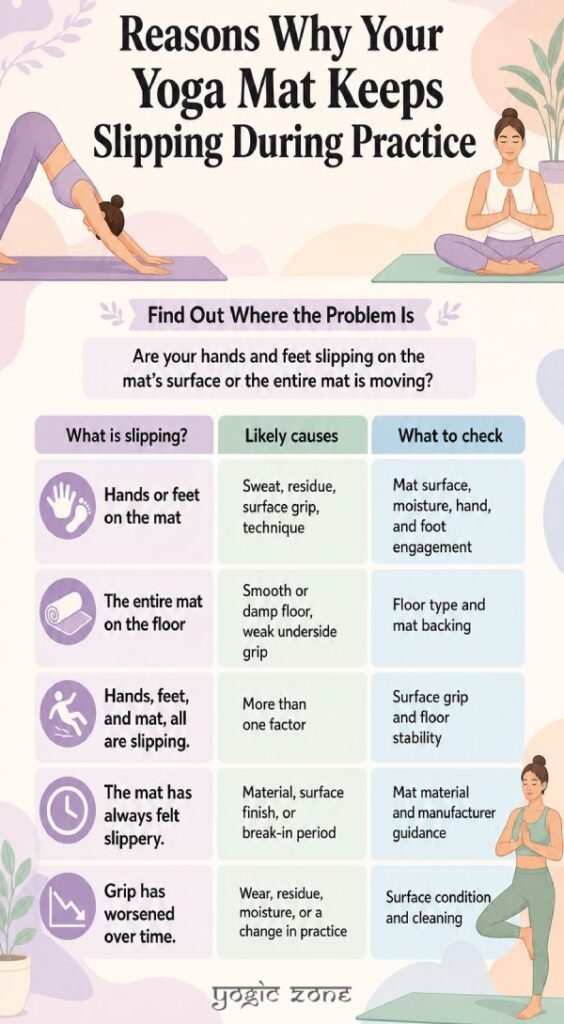
Yoga Mat Slipping? Causes and What to Check
| What is slipping? | Likely causes | What to check |
|---|---|---|
| Hands or feet on the mat | Sweat, residue, surface grip, technique | Mat surface, moisture, hand, and foot engagement |
| The entire mat on the floor | Smooth or damp floor, weak underside grip | Floor type and mat backing |
| Hands, feet, and mat, all are slipping. | More than one factor | Surface grip and floor stability |
| The mat has always felt slippery. | Material, surface finish, or break-in period | Mat material and manufacturer guidance |
| Grip has worsened over time. | Wear, residue, moisture, or a change in practice | Surface condition and cleaning |
This simple check can save you from replacing a perfectly usable mat when the actual problem is the type of floor, sweat, cleaning material residue, or your practicing technique.
Now let’s look at the possible causes one by one and see what you can do to solve the problem.
1. Your Hands and Feet Are Sweaty
Sweat is one of the most common reasons a yoga mat starts feeling slippery, particularly during faster or more physically demanding practices.
When your palms and soles become wet, they may lose their natural grip on the mat surface. This can become more noticeable during Adho Mukha Svanasana (Downward-Facing Dog), Plank, transitions, and standing asanas where your feet need to stay firmly grounded.
This is especially relevant in our hot and humid weather, particularly if you are practicing without air conditioning. Many of my students start sweating well before their practice even gets intense.
If your mat slips only when you sweat, the problem may simply be how sweat interacts with the mat surface, rather than the mat being old or unsuitable for you. In fact, yoga mat grip is a combination of material, surface texture, and moisture, rather than any single factor on its own.
Some mat materials handle moisture better than others. Cork is one example that is often considered for sweaty practices because its grip can improve as the surface becomes slightly damp.
However, the performance of cork mats can vary, so it is important to consider the mat’s overall construction rather than assuming that every cork mat will remain grippy when wet.
Students often ask me, “What is the “best yoga mat for sweaty hands?” Honestly, there’s no single answer; it depends on your practice style, how much you sweat, and your local climate, but moisture-friendly materials like cork and certain textured rubbers tend to perform better.
What you can do
- Keep a small towel nearby to wipe your hands and feet when necessary.
- If sweat is a regular problem for you, consider a yoga mat towel for grip, a microfiber towel made specifically for practice. Some are designed to grip better as they get damp.
- Allow the mat surface to dry between practices.
- If you regularly practice in a hot environment and are shopping for a yoga mat for hot and humid weather, pay attention to how the mat performs when wet, rather than judging its grip only when dry.
2. There is Residue on the Mat Surface.
A yoga mat can gradually collect residue from body oils, moisturisers, dust, sweat, and cleaning products.
Some cleaning products leave a fine film behind. Even when the mat looks perfectly clean, this residue can change how your hands and feet interact with the surface. It’s one of the most common reasons a mat that had good grip for months suddenly starts feeling slippery.
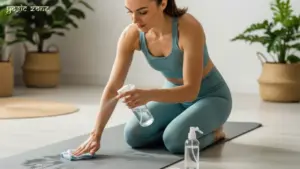
Regular yoga mat maintenance, cleaning it properly, and letting it dry is important. If you want to know the correct method of cleaning your mat properly, this guide on how to clean a yoga mat explains the process in detail.
What you can do
- Clean your mat according to the manufacturer’s instructions and make sure it dries completely before rolling it up.
- If your mat has become slippery after cleaning, check whether the cleaning product may have left a film on the surface.
- Avoid assuming that stronger cleaning products will make your mat cleaner or grippier. The wrong product can affect the surface of some mats.
- If you are unsure how to clean your particular mat, follow the manufacturer’s care instructions rather than experimenting with household cleaners.
3. The Floor Underneath the Mat is Slippery
Sometimes the mat itself is not the real problem.
A smooth tiled floor, polished stone floor, dusty surface, or damp floor can reduce the friction between the underside of the mat and the floor. You may notice that the entire mat moves during transitions or when you step firmly into a standing asana.
The important distinction is whether the mat itself is moving or your hands and feet are slipping across its top surface.
A simple test
Place the mat on the floor and press your hands firmly into it. Then try moving the mat forward and sideways with your hands.
If the whole mat moves, the issue is the contact between the mat’s underside and your floor. If your hands move across the top surface while the mat stays in place, the problem is more likely to be surface grip.
A weak yoga mat underside grip is often the real reason when the whole mat shifts on smooth or polished flooring, rather than anything to do with the top surface.
What you can do
- Make sure the floor is clean and dry before beginning your practice. Remove dust and moisture underneath the mat, particularly during monsoon weather.
- If your mat keeps moving on a smooth floor, look for a mat with a non-slip underside or a rubber backing that provides better traction against the floor.
- A non-slip yoga mat underlay is a simple, inexpensive solution if you are practicing on marble, granite, or polished stone.
- Before buying a new mat, check whether the problem is really the underside. If your hands and feet are slipping on the mat while the mat itself stays in place, you need better surface grip, not a more stable backing.
Do you have any doubts or questions about this article?? I am Lily Chetia, the author, and I would love to hear from you. Send us your question now!
4. Your New Yoga Mat May Need a Break-In Period
A new yoga mat can sometimes feel more slippery than expected when you first start using it. This does not necessarily mean the mat is defective or unsuitable for your practice. Some mats are designed to develop better traction with regular use.
This yoga mat break-in period is completely normal and doesn’t necessarily mean anything is wrong with your new mat. The break-in period may differ depending on the material and the manufacturer.
Some manufacturers provide specific instructions for preparing a new mat, while others simply recommend a few weeks of regular practice for the mat to become grippy.
Certain mats may have a manufacturer-approved salt treatment, but that does not mean a salt scrub is suitable for every yoga mat.
What you can do
- Check whether the manufacturer mentions a break-in period or preparation method for your particular mat.
- Use the mat regularly before deciding that the grip is unsuitable, unless the manufacturer advises otherwise.
- Follow the cleaning or break-in method recommended for your specific mat.
- If you are still dealing with sweat-related slipping on a new mat, a suitable yoga mat towel can provide additional grip while you get used to the surface.
- If you are considering replacing the mat, discuss your requirements with your yoga instructor. An experienced instructor may be able to suggest reliable, tried-and-tested mat brands or materials based on your practice style, how much you sweat, and the conditions in which you practice.
5. Your Mat Material May Not Suit Your Practice
Different yoga mat materials have different characteristics. A mat that works well for one person may not provide the same experience for someone else.
Some mats provide good dry grip but behave differently when exposed to considerable moisture. Others may feel very different depending on whether you are practicing slowly, moving through Vinyasa, or doing a more static practice.
This is why simply asking, “Which yoga mat has the best grip?” does not always have a straightforward answer. Your practice style, how much you sweat, the climate, and how you use the mat all matter.
What you can do
Think about when the slipping happens:
- Does it happen only when you sweat?
- Does it happen during particular asanas?
- Does the entire mat move?
- Did it happen from the first use?
- Has the grip changed over time?
These clues can help you determine whether the material or surface characteristics of your mat are contributing to the problem.
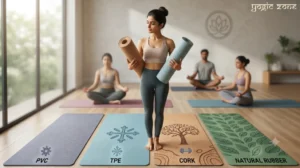
If you are comparing materials, look at how PVC, TPE, cork, and natural rubber differ rather than judging a mat only by its thickness or appearance.
6. Your Mat is Worn Out
Even a good or expensive yoga mat will not last forever.
With regular use, the surface can gradually change. It may become smoother, develop visible wear, lose texture, or start breaking down in places where your hands and feet repeatedly contact it.
If your mat provided good grip earlier but has gradually become slippery, wear and tear could be the reason.
Look closely at areas where you regularly place your hands and feet. These areas may show more wear than the rest of the mat.
Signs your mat may be wearing out
- The surface looks noticeably smoother than before.
- Grip has decreased despite proper cleaning.
- The material is cracking, peeling, flaking, or breaking down.
- Your hands and feet slide more than they used to.
- The mat no longer feels as stable as it did when new.
If the surface has significantly deteriorated, cleaning it differently may not solve the problem. It may simply be time to replace the mat.
7. Your Technique May Be Contributing to the Slipping
While we often look for problems with the mat itself, not every instance of slipping is caused by the mat.
Your hand and foot position can also affect stability. If your hands are not actively grounded or your weight is not distributed evenly, you may feel unstable even on a good grippy mat.
In some asanas, pressing your hands or feet into the mat in the wrong way can make you feel less stable and may cause them to slide.
In Adho Mukha Svanasana (downward-facing dog), for example, simply pressing harder into the mat is not always the answer. How you distribute your weight between your hands and feet and how you organise your body can affect how stable the asana feels.
You may also hear yoga teachers refer to Hasta Bandha, or the hand lock. In simple terms, it involves actively using your hands rather than passively placing your palms on the mat. Spread your fingers comfortably and press through the fingertips and the base of the thumb and index finger to create a more stable foundation.
What you can do
Instead of immediately replacing your mat, pay attention to what happens when you adjust your setup.
Try:
- Spreading your fingers comfortably.
- Grounding through your fingertips and the base of your thumb and index finger.
- Keeping your hands firmly placed rather than allowing them to shift.
- Checking that your feet are positioned securely.
- Slowing down transitions.
- Asking your yoga teacher to observe your alignment if you practice in a class.
If the mat stays firmly on the floor but your hands or feet continue to move, your technique may be contributing to the problem.
3 Questions to Ask Before You Blame Your Mat
Before buying a new mat, ask yourself these three questions. They can help you identify the cause instead of replacing a perfectly usable mat unnecessarily.
1. When does the slipping happen?
Is it during sweaty practice, specific asanas, or transitions?
2. Where does the slipping happen?
Are your hands and feet sliding on the surface, or is the entire mat moving on the floor?
3. Has the problem always existed?
If the mat has always felt slippery, its characteristics may not suit your practice. If the problem appeared recently, wear, residue, moisture, or changes in your practice may be more relevant.
Now We Know Why Your Yoga Mat Keeps Slipping
Now that we have looked at the possible causes, it is clear that a slippery yoga mat does not automatically mean you need a new one. The problem could be something as simple as sweat or moisture, or it could be related to the mat, the floor, your technique, or the way you practice.
The problem could be caused by:
- Sweaty hands and feet
- Residue on the mat surface
- A slippery floor underneath
- A new mat that needs a break-in period
- A mat material that does not suit your practice
- Normal wear and tear
- Technique or positioning
Start by identifying where and when the slipping happens. If your hands and feet slide while the mat stays firmly in place, look at surface grip, sweat, residue, or technique. If the entire mat moves across the floor, investigate the underside and the floor beneath it.
If your mat is new, check the manufacturer’s guidance before deciding that it is defective or unsuitable. If it has gradually lost its grip despite proper care, it may simply have reached the end of its useful life.
The right yoga mat is not necessarily the thickest, most expensive, or most popular one. It is the one that works well with your practice, your environment, and the way your body interacts with the mat.
If you are evaluating a yoga mat for your next purchase, our guide to the real benefits of a good yoga mat can help you understand what to look for.
Do you have any doubts or questions about this article?? I am Lily Chetia, the author, and I would love to hear from you. Send us your question now!
Frequently Asked Questions About Yoga Mat Keeps Slipping
Why is my new yoga mat so slippery?
A new yoga mat may feel slippery because of manufacturing process residue or its surface finish. Some mats also need a break-in period before they develop the right grip. Follow the manufacturer’s cleaning and care instructions.
How do I stop my hands and feet from slipping on my yoga mat?
Keep your hands and feet clean and dry, and check that the mat surface is free from sweat and residue. If slipping continues, your mat’s material or surface texture may not suit your practice.
Why does my yoga mat keep sliding on a hardwood or tiled floor?
The mat may be sliding because its underside does not grip the floor well or because the floor is smooth, dusty, or damp. Clean and dry both surfaces and check whether the mat is suitable for your floor type.
Why does my yoga mat feel slippery even if I am not sweating?
Sweat is not the only possible cause. Residue, dust, cleaning products, or the mat’s surface texture or material can affect grip. If the mat is new, it may also need some time to develop its intended grip.
How long does it take to break in a new yoga mat, and how can I speed it up?
The break-in period varies by mat material and as specified by the manufacturer. Follow the care instructions provided with your mat. Avoid harsh scrubbing or chemicals to speed up the process, as these may damage the surface.
Does spraying water on a yoga mat make it less or more slippery?
It depends on the mat’s material and surface. Water may improve or reduce grip on some mats, but it can also make the surface slippery. Do not spray water unless the manufacturer recommends it.
How do I clean my yoga mat to restore its original grip without damaging the surface?
Use the cleaning method recommended by the manufacturer. Avoid harsh chemicals, abrasive scrubbing, and excessive water unless specifically permitted. Allow the mat to dry completely before using it again.
How do I stop my yoga mat from sliding across smooth floors?
Make sure the floor and underside of the mat are clean and dry. If the mat still slides, its backing may not provide enough grip for that floor. Consider a mat designed for better floor traction.