
This article is written by Dr. Anuradha Singh. Ph.D. Vedic Yogas | M.Sc. in Psycho Neurobics | Yoga Therapist (AYUSH) | Sports Councillor | 10+ years of experience in yoga, meditation & mental health | Amazon Bestselling Author | Know more about Dr. Aradhana Singh.
How many of you were under the impression that flexibility is a requirement for starting yoga? The truth is that you can do yoga if you are not flexible. Flexibility is not a requirement for joining a beginner yoga class or starting your yoga practice at home.
In fact, if your body feels stiff, your hamstrings (back thigh muscles) are tense, or you cannot touch your toes comfortably, that should not stop you. They could even be some of the reasons why yoga may be right for you.
As a yoga instructor, I meet many beginners who hesitate to start because they think they are “too stiff for yoga.” Some tell me they cannot sit cross-legged or touch their toes comfortably. I advise them not to wait for their body to become flexible before starting yoga. A good beginner yoga practice starts with your body as it is today and gradually works on mobility, strength, balance, coordination, flexibility, and awareness.
Why Does Yoga Look Like You Need to Be Flexible?
If you have been seeing yoga reels on Instagram, YouTube, or other social media platforms, it is very easy to get the wrong idea. You see people effortlessly touching their toes, stretching their legs wide apart, or bending backwards with ease in advanced yoga poses.
These images usually show asanas being performed by people who have been practicing for years. With regular practice, you may also reach that level of flexibility. However, a beginner’s yoga class does not require you to reproduce those movements.
Do Not Compare Your Practice with Others
Two students starting yoga practice at the same time and practicing the same asana can have very different ranges of movement. One student may be able to place their hands on the floor easily in a forward bend. Another may need to bend their knees or use yoga blocks. Both can still practice the asana comfortably within their own range.
Someone who spends several hours sitting at a desk in an AC office may feel stiff around the hips and back. In comparison, someone with an active job who spends much of the day walking or moving around may have a different level of flexibility and mobility.
Your body structure, previous physical activity, age, and everyday habits can all influence how you move.
Do not treat flexibility as the main measure of progress in yoga. Being able to stretch farther is not the only sign that your practice is improving. Your yoga class includes breathing practices, relaxation, concentration, and awareness.
Is Flexibility the Only Thing That Matters?
I have noticed that when people say they want to become “more flexible,” they sometimes mean something that is related to flexibility but is not exactly the same. They may actually be talking about mobility or stability, which I believe are also important parts of a well-rounded yoga practice.
So, let’s understand the difference between flexibility, mobility, and stability. This will make it easier for you to understand what you should be working towards in your yoga practice.
| Concept | What it means | In yoga | Why it matters |
|---|---|---|---|
| Flexibility | The available range of movement | The range available to you in an asana | Can make some movements easier |
| Mobility | Your ability to actively move through and use that range | How comfortably you can get into an asana | Helps you move efficiently |
| Stability | Your ability to control and support movement | How well you can maintain the movement with control | Helps you control your range of movement |
You don’t have to compare yourself with anyone. Your body does not have to move like someone else’s
This is also an important point that beginners often overlook. I keep telling my students that every person’s body is anatomically and structurally different.
The shape and structure of your joints and bones can influence how much movement is available to you. Muscle strength, soft tissues, previous injuries, daily activity, and other factors can also affect how you move.
This means that there is no single “correct” depth that every person should reach in an asana. Your yoga practice should work with your body rather than forcing it to match somebody else’s range.
Do Not Force an Asana to Make It Look Perfect
One of the most common mistakes beginners make is trying to copy the final shape of an asana.
For example, if you cannot reach the floor in a standing forward bend, do not force yourself lower just to touch the floor.
You can bend your knees, use yoga blocks, or simply stop at a comfortable point for now. Remember, you are still practicing the movement.
I always tell my beginner students that a modified asana done with awareness is more useful than an asana done by forcing your body, which may also cause injury.
Do you have any doubts or questions about this article?? I am Dr. Aradhana Singh, the author, and I would love to hear from you. Send me your question now!
How Can You Modify Yoga Asanas If You Are Not Flexible?
Props can make an asana more accessible and help beginners with limited flexibility maintain better alignment, flexibility, mobility, and stability. Using props is not a sign of weakness or inefficiency; props help you respect your body’s limits instead of forcing yourself into positions that you may not yet be ready for.
Yoga blocks, straps, bolsters, and other props can each serve a different purpose. If you would like to understand how different yoga props can support your practice, explore our Yoga Props section.
• Use yoga blocks to bring the floor closer
If your hands cannot comfortably reach the floor, place yoga blocks underneath them. This can be particularly useful in standing forward bends and lunges.
• Use a yoga strap when your hands cannot reach
A strap can extend your reach without requiring you to force your body into a deeper stretch.
For example, in a seated forward fold, you can hold the strap around your feet rather than pulling yourself towards your toes.
• Use blankets and bolsters for support
If sitting on the floor is uncomfortable, a folded blanket or bolster can provide support and slightly change your position.
• A chair can also be a useful yoga prop
A sturdy chair can provide support for balance and can make certain movements more accessible.
Chair yoga is also a useful option for people with significant mobility limitations, balance concerns, or difficulty getting down to and up from the floor.
Read our articles on chair yoga for people with a stiff body and chair yoga for seniors to know how helpful this prop is.
Still Wondering Whether You Can Do Yoga if Not Flexible?
If you are still wondering whether you can do yoga if you are not flexible because your body feels stiff, the answer is yes. You do not have to become flexible first. You can begin with your current level of flexibility and gradually work on your mobility, strength, and balance.
What matters is that you do not force your body to achieve the full expression of an asana. With appropriate modifications and guidance from your yoga instructor, you can practice within a range that is comfortable and suitable for you.
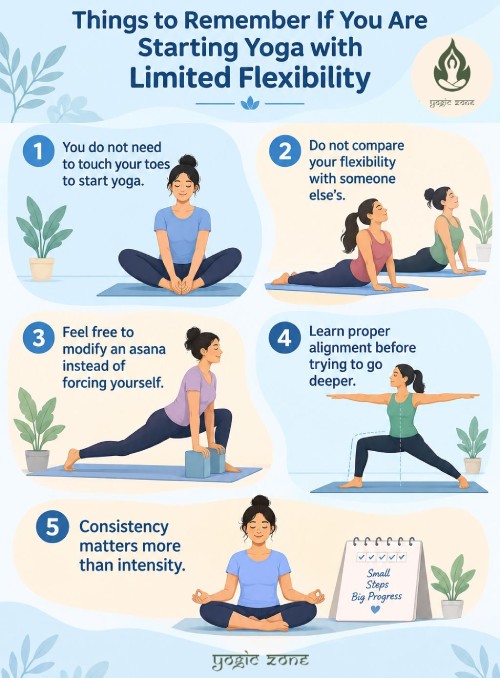
5 Things to Remember If You Are Starting Yoga with Limited Flexibility
- You do not need to touch your toes to start with
- Do not compare your flexibility with someone else’s
- Feel free to modify instead of forcing yourself
- Learn alignment before trying to go deeper
- Consistency matters more than intensity
How Often Should Beginners Practice Yoga to Improve Flexibility?
There is no fixed number of days that works for everyone. For most beginners, regular and consistent practice is more important than practicing for long periods or pushing hard.
Your yoga instructor can guide you on how often and how much you should practice based on your flexibility, mobility, and overall physical condition.
Let Your Yoga Instructor Guide You
Before you begin your yoga practice, share your relevant medical, physical, and lifestyle history with your yoga instructor. Let them know about any existing health concerns, previous injuries, physical limitations, daily activity levels, and other factors that may affect your practice.
Remember that limited flexibility does not stop you from starting your yoga practice. Strength, balance, coordination, and control are also important parts of your practice.
The important thing is to start at your current level rather than trying to reproduce an advanced asana you have seen online. Use props and modifications when needed, learn from an appropriately qualified instructor, and give your body time to develop.
Do you have any doubts or questions about this article?? I am Dr. Aradhana Singh, the author, and I would love to hear from you. Send me your question now!
Frequently Asked Questions About Can You Do Yoga If You Are Not Flexible?
Do you need to be flexible to start yoga?
No. You can start yoga at any level of flexibility. Yoga can gradually help improve mobility while you develop strength, balance, and body awareness.
Can yoga make you more flexible if you are very stiff?
Yes. Regular, professionally guided yoga practice can help improve your range of movement. Progress varies between individuals and should be gradual rather than forced.
How long does it take to become flexible with yoga?
There is no fixed timeline. Some people notice improved ease of movement within weeks, while meaningful changes in flexibility can take longer with consistent practice.
Can you do yoga if you can’t touch your toes?
It doesn’t matter if you cannot touch your toes. Use a yoga block to bring the floor closer when you bend your knees, and use a strap or stop at a comfortable range when practicing forward bends.
Can beginners do yoga if they have never exercised before?
Yes. You can join a beginner’s yoga class and gradually learn basic asanas at a pace that is suitable for you. Your instructor can suggest appropriate modifications based on your flexibility, mobility, strength, and overall physical condition.
Is it normal to feel stiff when starting yoga?
Yes. Many beginners have limited mobility, particularly around the hips, hamstrings, shoulders, or back. Start gradually and avoid forcing uncomfortable movements.
What is the difference between flexibility and mobility in yoga?
Flexibility is the available range of movement, while mobility is your ability to actively use that range of movement with control. In yoga, both flexibility and mobility are important, but they are not the same thing.