
Counselling Psychologist, Therapist & Yoga Teacher | Yoga RYT-900 AYUSH | Reiki Level 1 & 2 | Advanced Diploma in Counselling Psychology. Know more about Devin Lohana
When students ask me which yoga prop they should buy first, my answer is always the same – buy a yoga block. A yoga block is one of the most versatile and essential yoga accessories for any yogi, especially a beginner. It helps you find proper alignment and provides crucial support when your flexibility or balance feels a little shaky.
Very often, the next question is: “Should I choose cork or foam yoga blocks?” It’s an important question because the right block can completely transform your experience, while the wrong one can feel unstable and uncomfortable under your hands.
Over the years, as an RYT 900 yoga teacher, I have seen how different yoga blocks support different bodies and practice styles. Foam yoga blocks feel soft, light, and friendly, which is why I usually suggest them to beginners and anyone with sensitive joints.
Cork blocks feel solid, grounded, and have an excellent grip, so they work best in hot yoga classes and balance‑heavy asanas. In this guide, we will look at the difference in comfort, stability, grip, and price between cork and foam so you can decide which yoga block material actually suits your practice.
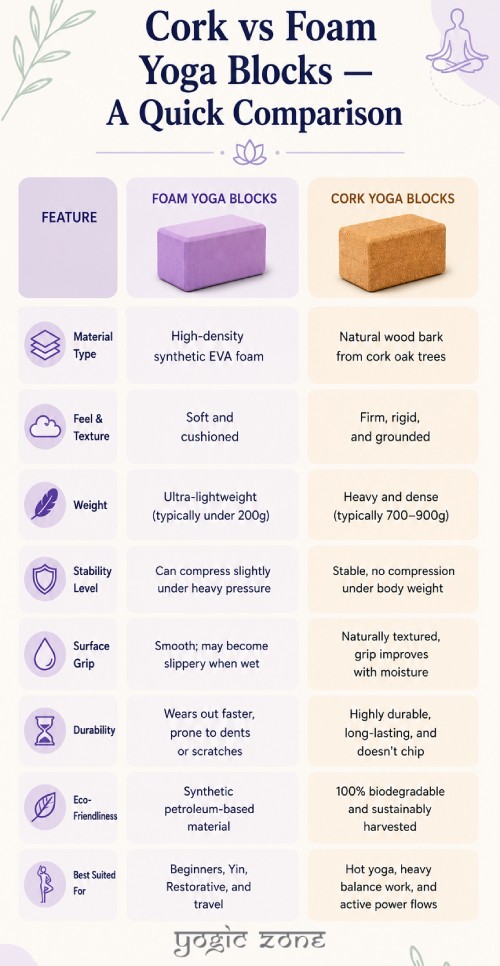
Cork vs Foam Yoga Blocks—Quick Comparison
In the following comparison table, I have simplified the important specifications and performance differences between the two materials:
| Feature | Foam Yoga Blocks | Cork Yoga Blocks |
|---|---|---|
| Material Type | High-density synthetic EVA foam | Natural wood bark from cork oak trees |
| Feel & Texture | Soft and cushioned | Firm, rigid, and grounded |
| Weight | Ultra-lightweight (typically under 200 gms) | Heavy and dense (typically 700–900 gms) |
| Stability Level | May compress slightly under heavy pressure | Stable, no compression under body weight |
| Surface Grip | Smooth; may become slippery when wet | Naturally textured, grip improves with moisture |
| Durability | Wears out faster, prone to dents or scratches | Highly durable, long-lasting, and doesn’t chip |
| Eco-Friendliness | Synthetic petroleum-based material | 100% biodegradable and sustainably harvested |
| Best Suited For | Beginners, Yin, Restorative, and travel | Hot yoga, heavy balance work, and active power flows |
| Approx. Indian Pricing | Budget-friendly (Starts around Rs. 250.00 per block) | Premium investment (Starts around Rs. 700.00 per block) |
What Is the Difference Between Cork and Foam Yoga Blocks?
When comparing cork vs foam yoga blocks, I usually focus on five important factors:
- Comfort
- Stability
- Grip
- Weight
- Durability
Remember, neither block is better for everyone. The right choice depends on your yoga style, comfort, and the kind of support your body needs.
Which Yoga Block Is More Comfortable?
In my experience, comfort matters most during slower, floor-based styles of yoga where you hold poses for several minutes and direct pressure is applied to bone and joint.
Foam yoga blocks are usually more comfortable because they provide soft cushioning under sensitive areas like:
- Knees
- Wrists
- Back
- Hips and Thighs
Cork blocks feel firm. If you hold a supported Setu Bandhasana (supported bridge pose) for five minutes on a cork block, it can feel a bit too hard against your tailbone or spine if you have sensitive joints. In these cases, a foam yoga block for sensitive joints is genuinely the better choice.
Which Yoga Block Is More Stable?
Cork yoga blocks are generally more stable because they do not compress easily under body weight. They provide a solid foundation that makes you feel grounded.
Foam blocks can compress or wobble slightly when you lean on them, which can reduce yoga block stability during demanding weight-bearing yoga poses. If a block compresses under pressure, your alignment can shift, which may increase the risk of a wrist strain or a fall.
Which Yoga Block Has Better Grip?
Cork yoga blocks usually provide better grip, especially during sweaty practice sessions. The natural cork texture acts as a non-slip surface and becomes slip-resistant with slight moisture.
Foam blocks have a smooth, non-porous surface. When your palms begin to sweat, moisture collects on top of the synthetic material rather than being absorbed, which can cause your hands to slip or slide forward unexpectedly.
Which Yoga Block Is Lighter?
Foam yoga blocks are much lighter than cork. Most standard high-density foam blocks weigh under 200 grams, while a dense cork block can weigh anywhere from 700 to 900 grams.
This massive weight difference makes foam blocks much easier to:
- Pack and carry to a local yoga studio or park
- Foam is the best lightweight yoga block for travel. Pack inside your luggage for travel yoga.
- Move and reposition quickly mid-flow during fast-paced Vinyasa transitions
What Are Foam Yoga Blocks Made Of?
If you are shopping for props online, you will often notice terms like EVA foam or closed-cell foam. Understanding these materials helps you avoid purchasing low-quality props. If you are new to yoga, I would advise you to read our article on yoga prop benefits.
Most good quality foam yoga blocks are made from high‑density EVA (Ethylene‑Vinyl Acetate) foam, a synthetic closed‑cell material. Closed‑cell EVA blocks resist moisture, feel firmer, and hold their shape better, which makes them easier to clean and more durable.
Foam yoga blocks are available in different densities. High-density EVA blocks feel firmer, more stable, and more durable, while softer low-density blocks provide extra cushioning but may compress more quickly.
Economical open‑cell foam blocks tend to absorb sweat, compress faster, and wear out more quickly, so whenever possible, I recommend choosing closed‑cell EVA foam blocks for longer‑lasting support.
Do you have any doubts or questions about this article?? Devin Lohana, the author, would love to hear from you. Send us your question now!
What Are Cork Yoga Blocks Made Of?
Cork yoga blocks are made from the natural bark of cork oak trees, making them one of the most sustainable yoga block options available. Premium cork blocks use densely packed, fine‑grain composite cork that feels smooth on the skin, lasts for years, and resists chipping.
Budget cork blocks are often made from larger cork chunks glued together; over time these pieces can dry out, flake, or lose their corners. If possible, invest in a fine‑grain cork block for better comfort and longevity.
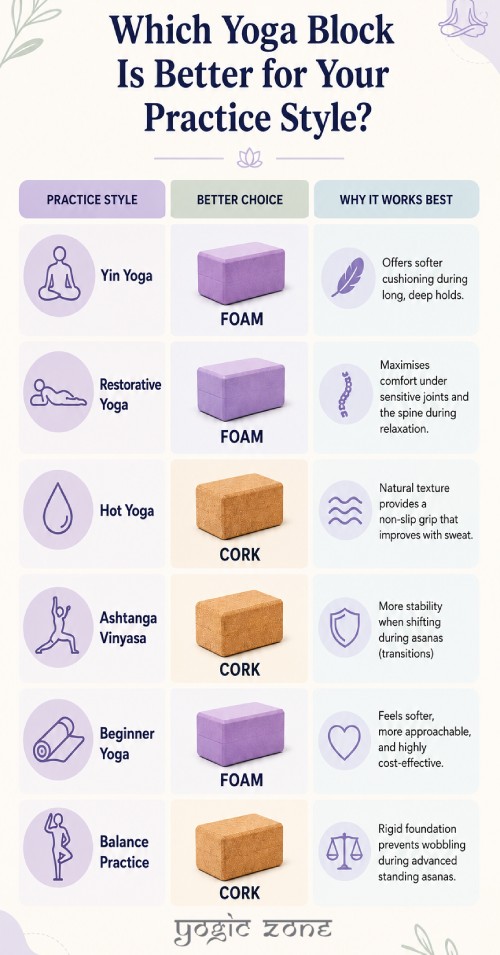
Which Yoga Block Is Better for Your Practice Style?
To help you choose the right block for your practice, this reference table highlights the ideal option for common yoga styles:
| Practice Style | Better Choice | Why It Works Best |
|---|---|---|
| Yin Yoga | Foam | Offers softer cushioning during long, deep holds. |
| Restorative Yoga | Foam | Maximises comfort under sensitive joints and the spine during relaxation. |
| Hot Yoga | Cork | Natural texture provides a non-slip grip that improves with sweat. |
| Ashtanga Vinyasa | Cork | More stability when shifting during asanas (transitions) |
| Beginner Yoga | Foam | Feels softer, more approachable, and highly cost-effective. |
| Balance Practice | Cork | Rigid foundation prevents wobbling during advanced standing asanas. |
Yoga Block Sizes
Beyond the material, you should pay close attention to the physical dimensions and edges of a block before purchasing. Yoga block dimensions directly affect how much reach and support you get. ,Most blocks come in two standard sizes:
- Standard 4-inch Blocks (4 x 6 x 9 inches): This is the most preferred size. I highly recommend a 4-inch thickness for beginners because the extra height provides a better reach. If you struggle with stiff hamstrings or hips, the block will effectively “bring the floor closer to you.”
- Slimmer 3-inch Blocks (3 x 6 x 9 inches): This narrower size features a slimmer profile. It is highly preferred by practitioners with smaller hands who find a 4-inch block difficult to grasp firmly, or by flexible yogis who only need a subtle lift.
My Pro-Tip: Always check the edge design. Blocks with rounded edges will be more comfortable under your hands, spine, or head. Blocks having sharp, 90-degree corners dig into your skin during long, restorative holds and are painful.
Hygiene, Cleaning, and Maintenance of Yoga Blocks
Many students worry about keeping their props clean and odour-free over months of regular use. Do read our guide on yoga mat cleaning.
How to Clean Foam Yoga Blocks
Closed-cell EVA foam yoga blocks are completely non-porous, meaning they do not absorb sweat, moisture, or bacteria. This makes them hygienic and low-maintenance.
- Method: Wipe down the surface with a damp cloth and mild soap or a gentle dishwashing liquid.
- Care Note: Some premium foam blocks can even be briefly rinsed under running water or submerged for a deep clean. Always allow them to air dry completely away from direct sunlight.
- Longevity: Despite being easy to clean, foam degrades faster. With daily use, a foam block will typically start compressing, deforming, or losing its edges within 2 to 3 years. This is worth considering if you use your block daily for knee support or as a yoga block for bad knees.
How to Clean Cork Yoga Blocks
Cork is an organic material; it contains natural antimicrobial properties that make it inherently resistant to fungus and common pests. This makes cork one of the most hygienic and eco-friendly yoga props you can own.
Research has shown that cork surfaces can significantly reduce certain types of bacteria, making cork a naturally hygienic material.
- Method: Wipe the surface gently using a clean, damp cloth after a sweaty practice session.
- Care Note: Never soak or submerge a cork block in water. Avoid using harsh chemical surface cleaners, abrasive detergents, or concentrated essential oils, as these can chemically break down the natural organic binders holding the fine-grain cork together.
- Longevity: A well-cared-for, high-quality composite cork block is a good investment. If you are wondering, how long do cork yoga blocks last? it can easily last 5 to 10 years without losing its density, shape, or firmness.
Final Recommendation: Which Should You Choose?
The right choice ultimately depends on your practice style, comfort needs, and how you plan to use the block. Here is a simple way to decide.
Choose Foam Yoga Blocks If You:
- Are a beginner starting your yoga journey and exploring props for the first time.
- Primarily practice gentle, slow, restorative, or Yin yoga.
- Have highly sensitive joints, bad knees, or tender wrists that require plush cushioning.
- Prefer an ultra-lightweight block that is easy to pack and travel with.
- You are on a budget or want to try and want an affordable entry point.
Choose Cork Yoga Blocks If You:
- Have an advanced or intermediate practice and need an absolutely stable foundation.
- Regularly practice hot yoga, power yoga, or fast-paced Ashtanga flows where hands get sweaty.
- Prioritise maximum grip, alignment precision, and solid balance support.
- You prioritise sustainability, eco-friendly materials, and biodegradable products.
- Want a durable, professional-grade block that will withstand years of daily use.
Can You Use Both Cork and Foam Yoga Blocks Together?
Absolutely! Many experienced practitioners own both. Foam blocks work very well for restorative yoga, yin yoga, and gentle mobility sessions, while cork blocks are excellent for hot yoga, standing poses, balance work, and active flows where extra stability is important.
I always recommend buying two blocks rather than just one. Most structural postures require a pair of blocks to ensure perfect pelvic symmetry, support both hands evenly across your chest line, or rest comfortably under both knees simultaneously.
Remember, there is no such thing as the “best” yoga block for everyone. The best yoga block is the one that supports your body and complements the way you actually practice.
If you are unsure, start with a good-quality foam block. As your practice evolves, you may naturally transition toward cork or decide to keep both.
Do you have any doubts or questions about this article?? Devin Lohana, the author, would love to hear from you. Send us your question now!
Frequently Asked Questions About Cork Vs Foam Yoga Blocks
Are cork yoga blocks better than foam for beginners?
Foam yoga blocks are usually better for beginners because they feel softer, lighter, and more comfortable under the hands and joints. However, some beginners prefer cork blocks for the extra stability they provide in standing and balance-focused poses.
Are foam yoga blocks stable enough for seniors?
Foam blocks are wonderful for seniors because they are lightweight and easy to move around. While they are stable for gentle support, they can compress or wobble under heavy weight. If balance is a major concern, a sturdier block might offer more peace of mind.
Which is better for restorative yoga: cork or foam blocks?
Foam yoga blocks are generally better for restorative yoga because they provide gentler cushioning during long-supported poses. Cork blocks offer firm support but may feel too hard under sensitive areas like the spine, hips, or lower back.
Should I avoid cork yoga blocks if I have severe wrist pain or sensitive joints?
If you have severe wrist pain or sensitive joints, foam yoga blocks are usually the safer and more comfortable option. Their softer cushioning reduces pressure on the wrists, knees, and spine during supported poses and gentle yoga practice.
Is it safe for a senior citizen with balancing issues to use a lightweight foam block?
Yes, a dense high-quality foam yoga block is usually safe for seniors during gentle or chair-supported yoga. However, very soft foam blocks may compress too much, so stable, high-density blocks are generally a better choice for balance support.
Can I trust a foam block not to wobble or compress during a full-weight standing balance pose?
Dense foam yoga blocks can support many standing poses, but they may still compress slightly under full body weight. For stronger balance poses or weight-bearing asanas, cork blocks usually provide a more stable and dependable foundation.
What if my hands sweat a lot during practice—will a foam block slip more than a cork one?
Yes, foam blocks can become slippery during sweaty practice sessions. Cork yoga blocks usually provide better grip because the natural cork texture becomes slip-resistant with slight moisture, making them ideal for hot yoga and dynamic flows.
Should I invest in heavier cork blocks if I only practice gentle, slow-paced yoga at home?
Not necessarily. If your practice is mostly restorative, yin, or gentle home yoga, foam blocks are often more comfortable and practical. Cork blocks are more useful when stability, balance support, or durability becomes a priority.
Is it safe to use a cork block under my spine or tailbone, or will it be too hard and cause injury?
Cork blocks are generally safe when used correctly, but they can feel too firm under the spine or tailbone during long-supported poses. If you have sensitivity in these areas, foam blocks usually provide more comfortable cushioning and support.
How often do foam yoga blocks lose their shape, and will they need to be replaced much sooner than cork?
With regular use, foam yoga blocks may begin compressing, denting, or losing shape within a few years, especially lower-quality ones. Cork blocks usually last much longer because they retain their firmness and structural stability over time.