
Internationally Certified Yoga Trainer | Level 3 AYUSH | Hatha & Ashtanga Vinyasa Specialist | Mindfulness Coach | Limca Record Holder | Know more about Chirag Sejpal.
Choosing a yoga mat isn’t just about colour, thickness, or price. The mat material plays a bigger role than most people realise. It affects grip, comfort, durability, portability, maintenance, and even how confident you feel during practice.
In India, the decision becomes even more important. Hot summers, humid monsoons, dusty environments, and daily commuting can all influence how different yoga mat materials perform. A mat that works wonderfully in an air-conditioned studio may not feel the same during a humid morning practice or when carried to class every day.
One of the questions I hear most often after class is, “Which yoga mat should I buy?” Over the years, I have seen many students choose a mat based on price or online reviews, only to replace it a few months later because it became slippery, felt too heavy to carry, or simply didn’t suit their practice.
The truth is, there isn’t one yoga mat material that’s perfect for everyone.
PVC, TPE, cork, and natural rubber all have distinct strengths and limitations. The right choice depends on how you practice, where you practice, and what matters most to you.
I have compiled this guide to help you compare PVC, TPE, cork, and natural rubber. Instead of looking for the “best” material, you will learn the strengths and limitations of each so you can choose the one that best matches your practice, lifestyle, and budget.
Quick Recommendations Based on Your Priorities
If you’re looking for a quick recommendation before exploring the details, here’s a simple starting point.
| If your priority is... | Best Choice |
|---|---|
| Buying your first yoga mat | PVC or TPE |
| Lowest budget | PVC |
| Lightweight and easy to carry | TPE |
| Sweaty practice | Cork |
| Maximum grip | Natural Rubber |
| Long-term durability | Natural Rubber |
| Eco-friendly materials | Cork or Natural Rubber |
| Daily commuting | TPE |
If you’re still deciding between two or more materials, keep reading. The detailed comparison below will help you understand the strengths and limitations of each material, making it easier to choose the right yoga mat for your practice.
What Should You Compare Before Choosing a Yoga Mat Material?
Rather than asking which mat material is “best,” let us compare the factors that will affect your daily practice.
• Grip
Grip determines how secure you feel during standing asanas, balancing postures, and dynamic transitions.
If you practice gentle Hatha yoga a few times a week, almost any quality mat provides sufficient grip. However, practitioners who sweat heavily or enjoy Vinyasa or Ashtanga Yoga often benefit from a non-slip yoga mat that maintains traction even when moisture builds up.
• Weight
If your mat rarely leaves home, weight may not matter very much. But if you commute by metro or travel to studio classes, a lighter material quickly becomes more practical.
• Durability
Some materials cope better with regular use than others. If you practice most days of the week, spending a little more on a durable mat can provide better long-term value than replacing a cheaper mat every year.
• Sustainability
If reducing environmental impact matters to you, cork and natural rubber are generally the better choices. If affordability or portability is your priority, synthetic materials like PVC and TPE may suit you better.
• Budget
A higher price doesn’t automatically mean a better yoga mat. The best value comes from choosing a material that matches your practice rather than paying for features you may never use.
Do you have any doubts or questions about this article?? I am Chirag Sejpal, the author, and I would love to hear from you. Send me your question now!
PVC vs TPE vs Cork vs Rubber Yoga Mats: Side-by-Side Comparison
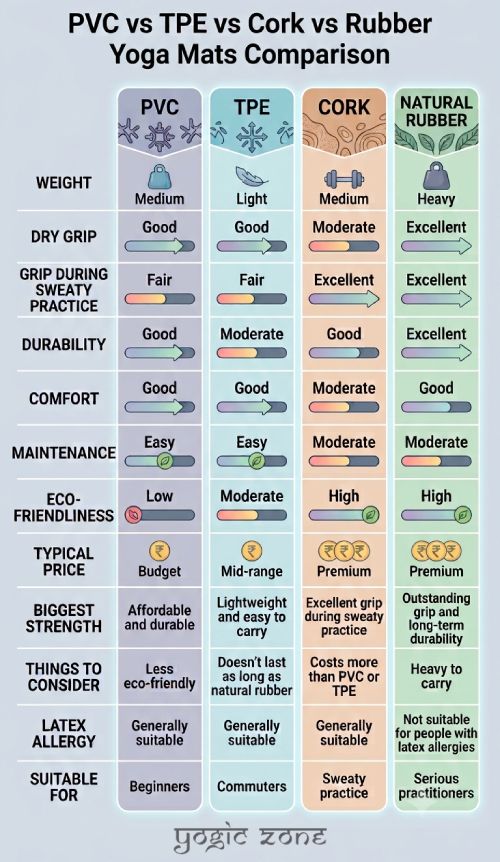
| Feature | PVC | TPE | Cork | Natural Rubber |
|---|---|---|---|---|
| Weight | Medium | Light | Medium | Heavy |
| Dry Grip | Good | Good | Moderate | Excellent |
| Grip During Sweaty Practice | Fair | Fair | Excellent | Excellent |
| Durability | Good | Moderate | Good (depending on base and handling) | Excellent |
| Comfort | Good | Good | Moderate | Good |
| Maintenance | Easy | Easy | Moderate | Moderate |
| Eco-friendliness | Low | Moderate | High | High |
| Typical Price | Budget | Mid-range | Premium | Premium |
| Biggest Strength | Affordable and durable | Lightweight and easy to carry | Excellent grip during sweaty practice | Outstanding grip and long-term durability |
| Things to Consider | Less eco-friendly | Doesn't last as long as natural rubber | Costs more than PVC or TPE | Heavy to carry |
| Latex allergy | Generally suitable | Generally suitable | Generally suitable | Not suitable for people with latex allergies |
| Odour when New | Moderate | Low | Very Low | Moderate |
| Suitable For | Beginners | Commuters | Sweaty practice | Serious practitioners |
I always tell my students that instead of looking for a material that scores highest in every category, identify the qualities that matter most to you. Every material involves some level of compromise.
PVC Yoga Mats
PVC (Polyvinyl Chloride) remains one of the most widely used yoga mat materials because it offers dependable yoga mat cushioning at an affordable price. For new students practicing two or three times a week, it provides excellent value as a yoga mat for beginners.
Where PVC Mats Perform Well
- Affordable and widely available.
- Good balance of cushioning and durability.
- Easy to wipe clean, making yoga mat maintenance simple. For detailed care tips, read our Ultimate Guide to Yoga Mat Cleaning.
- Suitable for gentle Hatha yoga and general home practice.
- A good-quality PVC mat can last for years with regular use.
Where PVC Mats Fall Short
- Grip may reduce during very sweaty practice.
- Less environmentally friendly than cork or natural rubber.
- Budget-quality mats may have a noticeable plastic odour.
- Heavier than TPE, making it less convenient for frequent commuting.
Who should choose PVC yoga mats?
PVC is an excellent choice if you:
- are buying your first yoga mat
- Practice gentle Hatha yoga or beginner classes.
- want dependable performance without spending a premium
- prefer a mat that’s easy to maintain
TPE Yoga Mats
TPE (Thermoplastic Elastomer) has become increasingly popular as a lightweight yoga mat with comfortable cushioning. For many students who travel regularly to yoga classes, it’s one of the most practical options available.
Where TPE Mats Perform Well
- Lightweight and easy to carry, making TPE one of the best yoga mat materials for people who commute daily.
- Comfortable cushioning.
- Usually has little or no noticeable odour.
- More environmentally friendly than PVC.
- Suitable for studio classes, travel, and home practice.
Where TPE Mats Fall Short
- Doesn’t last as long as a good-quality natural rubber mat.
- Grip may reduce during very sweaty practice.
- Lower-quality mats may wear or peel with frequent use.
- Less stable than natural rubber during demanding practice.
Who should choose TPE mats?
TPE is an excellent option if you:
- regularly carry your yoga mat
- Attend studio classes after work.
- Want a lightweight everyday mat
- Need a latex-free yoga mat as an alternative to natural rubber
Cork Yoga Mats
Cork stands apart from other yoga mat materials because its grip behaves differently. While many mats become slippery as your hands and feet perspire, cork becomes grippier with a little natural moisture.
This unique characteristic makes it one of the best yoga mat materials for practitioners with sweaty hands. It’s especially popular among people who practice hot yoga, sweat heavily, or practice in warm, humid conditions.
Where Cork Mats Perform Well
• Grip improves as your hands and feet perspire.
• Naturally resistant to odours.
• Comfortable to practice on in warm and humid weather.
• A biodegradable yoga mat made from a renewable material.
• Suitable as a hot yoga mat, offering reliable grip in heated studios.
Where Cork Mats Fall Short
• More expensive than PVC and TPE mats.
• May feel less grippy until a little moisture develops.
• A firmer surface may not suit everyone.
• Takes a little longer to dry before storage.
Who Should Choose Cork?
Cork is an excellent choice if you:
- Sweat heavily during practice
- Regularly practice Vinyasa or other dynamic styles
- Want a mat made from renewable materials
- Often practice in warm or humid conditions
My practical advice
Many beginners judge a cork mat after a single class. I usually recommend practicing on it for at least a week before deciding. Once your hands and feet develop a little natural moisture, most people notice a significant improvement in grip.
Natural Rubber Yoga Mats
Natural rubber is widely regarded as the premium choice for practitioners who prioritise grip, stability, and long-term durability. Although it’s usually the heaviest of the four materials, it’s also the one I most often recommend to students who practice regularly at home.
Where Natural Rubber Mats Perform Well
• Exceptional grip in both dry and sweaty conditions.
• Excellent stability for balancing and standing asanas.
• Outstanding yoga mat durability for regular, long-term practice.
• Made from a natural, renewable material.
• Ideal for home practice and dynamic yoga styles.
Where Natural Rubber Mats Fall Short
• Heavier than PVC, TPE, and cork mats.
• Usually the most expensive option.
• Not suitable for people with latex allergies.
• Less convenient if you carry your mat every day.
Who Should Choose Natural Rubber?
Natural rubber is ideal if you:
- Practice several times a week
- Mainly practice at home or in a studio
- Want best overall grip and stability
- Value long-term durability over portability
How Indian Conditions Can Influence Your Choice
Many international reviews evaluate yoga mats in air-conditioned studios, but everyday practice in India presents different challenges. Heat, humidity, dust, and frequent commuting can all affect how a yoga mat performs over time.
Rather than choosing a different mat for every season, think about the conditions in which you practice most often.
| Situation | Material That Usually Performs Best |
|---|---|
| Hot, dry summers | Cork or Natural Rubber |
| Humid coastal cities | Cork or Natural Rubber |
| Daily commuting | TPE |
| Mostly home practice | Natural Rubber or PVC |
| Gentle beginner practice | TPE or high-quality phthalate-free PVC |
Matching the material to your environment is usually more beneficial than chasing the highest-rated mat online.
Still Not Sure? Here’s My Advice
If you’re still deciding, don’t worry. There isn’t one yoga mat material that’s perfect for everyone. The right choice depends on what matters most to you.
- Choose PVC if you’re buying your first yoga mat and want an affordable, durable option.
- Choose TPE if you need something lightweight that’s easy to carry to classes or while travelling.
- Choose Cork if sweaty hands or humid conditions are your biggest concern.
- Choose Natural Rubber if you practice regularly and want the best grip, stability, and long-term performance.
Instead of asking, “Which yoga mat material is the best?” ask yourself, “Which material best matches the way I practice?” Once you have identified your priority, whether it’s affordability, portability, grip, durability, or reducing environmental impact, the right choice becomes much clearer.
As a yoga trainer, I always encourage students to prioritise grip, stability, and comfort over brand names or marketing claims. The best yoga mat is the one that supports your style of practice consistently and helps you move with confidence and awareness.
Do you have any doubts or questions about this article?? I am Chirag Sejpal, the author, and I would love to hear from you. Send me your question now!
Frequently Asked Questions About Yoga Mat Material
Which yoga mat material is best for knee pain?
Choose a 5–6 mm thick mat with high-density cushioning. While materials like TPE or natural rubber offer great shock absorption, thickness matters more than material. Avoid thin mats under 4 mm, which fail to protect sensitive knees.
Are cork yoga mats better than rubber for sweaty hands?
Natural rubber provides excellent grip in sweaty conditions, but cork becomes noticeably grippier as moisture increases. This makes cork the preferred choice for practitioners with very sweaty hands or those practicing hot yoga.
Is it safe to use cheap PVC yoga mats for daily practice?
It is safer to avoid them. Non-certified cheap PVC mats may contain phthalates or plasticisers. For safe daily practice and breathwork, opt for certified phthalate-free PVC or safer non-toxic alternatives like TPE or natural rubber.
Can I use a natural rubber yoga mat if I have skin allergies or sensitive skin?
Yes, unless you have a latex allergy. Natural rubber is safe for most skin types, but those with latex sensitivities must avoid it. If your skin is sensitive, check manufacturer details to ensure no harsh processing additives were used.
Should I get a lightweight TPE mat if I plan to carry it to my office yoga sessions?
Yes, absolutely. TPE is incredibly lightweight and easy to carry on public transport or during your office commute. It provides excellent daily cushioning without adding heavy bulk to your office bag.
Is it safe for seniors to use a cork yoga mat, or is it too slippery?
Cork has a naturally textured, non-slip grip that actually improves with slight moisture. For seniors, ensure it has a natural rubber base underneath to prevent sliding on the floor.
What if my new rubber yoga mat has a very strong chemical-like smell?
A mild natural rubber smell is normal and fades after a few days of airing. However, if the smell is unusually strong or resembles harsh chemicals, it may indicate low-quality manufacturing additives, and the product quality should be checked.
How often do I need to deep clean a TPE mat compared to a cork mat in India’s hot weather?
Wipe your TPE mat after sweaty sessions and deep clean it every 1–2 weeks, depending on how frequently you practice. Cork mats require less frequent deep cleaning because they are naturally resistant to odours and microbial growth when properly maintained.
Can I wash my cork or rubber yoga mat in a standard Indian washing machine?
No, it is not advisable. Machine washing will ruin cork and heavy rubber, causing them to crack or lose grip. Instead, gently wipe them down by hand using a damp cloth and a very mild soap solution.
Is it necessary to buy an expensive rubber mat as a complete beginner starting gentle yoga?
No, it is not necessary. If you are doing gentle, slow-paced yoga, a budget-friendly TPE mat offers plenty of comfort, grip, and joint support to start your journey comfortably. Only upgrade to premium rubber later if needed.