
M.Sc. Yoga | YIC SVYASA | 15+ yrs experience | therapeutic and traditional yoga | Yoga Therapy for back pain, lifestyle disorders & stress management | Corporate trainer | Know more about Ranjay Kumar.
If you are reading this, chances are you have felt a sharp pain in your knee while climbing stairs, or your knees protest every time you rise from low seating. For many of us, knee pain isn’t just discomfort, It can make a simple walk feel like a challenge. The good news is that a gentle routine with targeted yoga for knee pain can genuinely make walking easier and more comfortable.
With over 15 years of experience in Lifestyle Management through yoga and specialised work in Knee-Care & Joint Mobility, I have consistently observed that the most effective yoga for knee pain focuses on gentle strengthening, joint stability, and mindful movement — rather than forceful postures or prolonged strain on the knees.
Why Your Knees Hurt When You Walk
Knee discomfort often increases when the joint feels unstable, stiff, or overloaded during each step.
Your knee is essentially a hinge joint that depends on surrounding muscles for stability. When the quadriceps (front thigh muscles) and hamstrings (back thigh muscles) are weak or imbalanced, the kneecap may not move as smoothly as it should, making everyday movements feel less comfortable.
This may contribute to increased friction and discomfort with each step. Walking on uneven surfaces or repeatedly climbing stairs without a lift puts extra demand on these support muscles.
How Yoga Supports Easier Walking and Not Just Pain Relief
What most people miss is that doing random yoga asanas won’t automatically improve your walking. Yoga for knee pain helps when specific asanas support the Vastus Medialis, the teardrop-shaped muscle near your knee, while also easing tight hamstrings that can pull on the joint. Together, this improves alignment and reduces uncomfortable strain during movement.
A simple therapeutic yoga routine may help by:
- Strengthening the quadriceps, especially the inner quad (often linked with kneecap stability)
- Reducing stiffness through gentle movement that supports joint lubrication and knee mobility
- Improving balance and posture, so every step feels more controlled
This is exactly why yoga for knee pain works best, as stability comes first.
The Simple Knee-Friendly Yoga Routine for Stronger, Pain-Free Knees
Below are the yoga asanas for knee pain I prefer for beginners, especially those who fear squats or floor sitting. These knee-strengthening exercises are also suitable as chair yoga for seniors and anyone seeking knee pain relief.
Safety note: Consult your doctor or physiotherapist before starting if you have an injury, arthritis, recent surgery, or severe pain. Stop and come out of the asana immediately if discomfort increases.
Use props like a chair, wall, or cushion whenever needed to stay steady and protect your knees. You will find our blog on yoga props for beginners helpful.
1. Tadasana (Mountain Pose) for Stability
This simple standing asana teaches your body proper weight distribution across your feet, which directly affects knee alignment.
- Benefit: Builds postural control so your knee doesn’t take all the load while walking.
- Beginner tip: Practice near a wall or hold the back of a chair lightly if standing feels unstable.
- Safety note: Avoid locking your knees backward (hyperextension); keep your knees slightly relaxed, not locked.
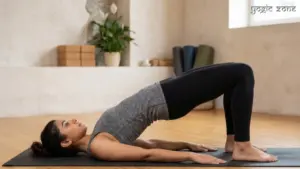
2. Setu Bandhasana (Bridge Pose) for Quadriceps Strength
This gentle yoga backbend supports lower-body strength through the hips and thighs, which indirectly helps improve knee stability and reduces excessive load on the knee joint.
- Benefit: Strengthens the back chain (buttocks + hamstrings), reducing stress on the knees during each step.
- Beginner tip: If lying flat on the floor is difficult, use a cushion under the hips for comfort or keep the lift minimal.
- Safety note: If you feel pressure behind your kneecaps, lift your hips only a little (keep it low and comfortable).
3. Trikonasana (Triangle Pose) for Hamstring Flexibility
Trikonasana gently stretches tight hamstrings while strengthening the muscles that support your knee joint and improving knee mobility.
- Benefit: Improves hip mobility and side-body strength, helping your walking stride feel smoother.
- Beginner tip: Can’t reach the floor? Rest your hand on a thick book stack, stool, or chair seat; a dupatta looped around your foot can also help if reaching down feels impossible.
- Safety note: Keep a slight bend in your front knee rather than locking it straight. Avoid twisting the knee; keep the foot-knee direction aligned. Those with active knee pain should keep a shorter stance and avoid forcing depth in the posture.
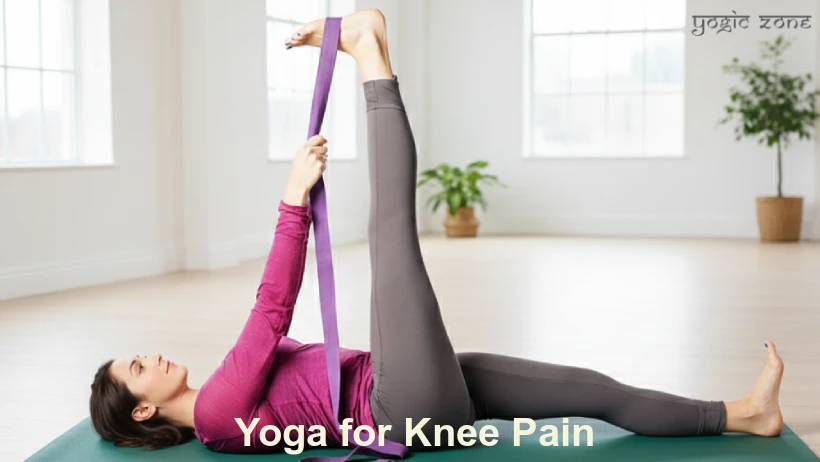
4. Supta Padangusthasana (Reclining Hand-to-Big-Toe Pose) for Gentle Hamstring Release
Supta Padangusthasana is done lying on the back with a belt/strap, this gives a controlled hamstring stretch, reducing pull on the knee.
- Benefit: Loosens tight hamstrings, which can pull the knee out of comfortable alignment.
- Beginner tip: Use a dupatta/gamcha if you do not have a yoga strap and keep the leg slightly bent.
- Safety note: Stretch gently, not deeply. A gentle release is enough.
5. Savasana (Corpse Pose) for Knee-Friendly Relaxation and Recovery
Savasana with supported relaxation (bolster under knees) is commonly included in knee-pain sequences to relax surrounding muscles.
- Benefit: Helps release muscular tension and supports relaxation, allowing the body to focus on recovery and healing.
- Beginner tip: If lying flat aggravates your knees, place a rolled blanket or firm pillow under your knees to take pressure off the joint.
- Safety note: Avoid this asana if you have severe lower back pain that worsens when lying flat.
Do you have any doubts or questions about this article?? I am Ranjay Kumar, the author, and I would love to hear from you. Send me your question now!
The 5-Minute Bed Routine for Morning Stiffness
If mornings feel stiff, do these micro-movements before you even get out of bed. This gentle yoga sequence is especially helpful for seniors or anyone who can’t sit on a mat comfortably. You can also explore gentle yoga for seniors for more options.
- Ankle circles (10 each direction per foot): Warms up the entire leg
- Knee-to-chest pulls (5 each leg): Gentle hip and hamstring wake-up
- Supine leg raises (8-10 reps): Activates quadriceps without weight-bearing
This micro-routine increases synovial fluid production and makes those first painful steps significantly easier.
Household Yoga Props Substitute Guide
If you don’t have yoga props handy, here are some simple household alternatives. Common Indian home items can replace blocks, straps, and other supports safely and comfortably.
| Yoga Prop Alternative | Household Substitute | Best For |
|---|---|---|
| Yoga block alternative | Thick books (stable stack) | Trikonasana support |
| Yoga strap substitute | Dupatta or gamcha | Hamstring support |
| Yoga bolster alternative | Cushion or folded blanket | Comfort in reclining poses |
| Yoga chair substitute | Dining chair | Balance + knee-safe support |
| Yoga mat alternative | Rug, non-slip carpet | Floor grip + cushioning for seated/lying poses |
| Yoga blanket alternative | Shawl, thick towel, comforter | Warmth + extra padding in restorative or meditation practices |
I always tell my students that props don’t mean you are “less flexible.” Props mean you’re practicing smart.
Knee-Safe Yoga Practice Guidelines
Avoid asanas that force deep knee bending, intense twisting, or prolonged pressure on the joint, and don’t attempt unfamiliar asanas without consulting your yoga instructor.
A little clicking or popping without pain is usually not a problem and can happen naturally as the joint moves. But if the sound comes with sharp pain or a feeling of instability, stop immediately and consult an orthopedic specialist.
In my teaching experience, I have found that consistency, correct alignment, and patience are far more important than intensity when working with knee pain through yoga.
Building Your Yoga for Knee Pain Routine
Start with just 10 minutes daily, focusing on 2-3 asanas that feel manageable. Gradually increase duration and add complexity as your strength builds. The goal isn’t perfection in the asana but consistent, mindful movement that helps your knees.
Remember that yoga for knee pain is a gradual healing process, not a quick fix. While therapeutic yoga can support knee health and may help reduce discomfort, it’s not a replacement for medical care. These yoga asanas for knee pain are particularly effective for conditions like yoga for arthritis when practiced consistently.
If your pain is severe, accompanied by swelling, or limits your daily activities significantly, consult an orthopedic specialist or physiotherapist. Work with a certified yoga instructor who can provide personalised modifications for your specific condition.
Do you have any doubts or questions about this article?? I am Ranjay Kumar, the author, and I would love to hear from you. Send me your question now!
Frequently Asked Questions About Yoga For Knee Pain
Is it safe to do yoga for knee pain if I have severe arthritis or a meniscus tear?
Gentle yoga can help, but please consult your doctor first. Start with chair poses and avoid deep bends until you get proper medical clearance for your condition.
Is yoga safe for seniors with severe knee pain or osteoarthritis?
Yes, many seniors do well with yoga when it’s slow, supported, and low-impact. Use a chair, wall, and blocks for safety.
Which specific yoga asanas should I avoid to prevent making my knee pain worse?
Avoid deep squats, Virasana, and Padmasana initially. Skip any pose that twists your knee or puts weight on bent knees until your strength improves naturally.
Can I start a yoga routine for knee pain if I can’t sit cross-legged or bend my knees fully?
Absolutely! Sit on a chair or cushion instead. Many effective knee-strengthening poses work while standing, lying down, or sitting with legs extended comfortably.
Should I continue the routine if I hear clicking or popping sounds in my knees while moving?
Painless clicking is often harmless. But if you feel pain, swelling, or instability with the sounds, stop immediately and consult your healthcare professional.
Is it safe for a beginner over 60 to do yoga for knee strengthening without a physical instructor?
Start with simple movements and use a chair for balance. However, one or two sessions with an instructor helps you learn proper alignment and avoid common mistakes.
Is it safe to use this routine for recovery after a knee replacement surgery?
Only with your surgeon’s approval. Post-surgery yoga requires specific timing and modifications that depend on your healing progress and individual medical situation.
How often do I need to do these exercises before I notice an improvement in my walking pace?
Practice 3-4 times weekly for best results. Most people feel better within 2-3 weeks, but improvement timing varies based on your strength and consistency.
Can I do these yoga poses while wearing a knee cap or support brace for extra stability?
Yes, you can wear your brace during practice if it helps you feel secure. Just ensure it’s not too tight and doesn’t restrict movement or blood circulation.
Should I choose Hatha yoga or Chair yoga if my main goal is to avoid putting weight on my joints?
Chair yoga is gentler for sensitive knees since you stay seated. Hatha yoga requires standing. Hatha can work later with modifications once your knees feel steadier.